This is a useful little tip that could have saved multiple companies I have worked with lots of money, particularly at the beginning of a migration or evaluation of a new cloud service project.
So you have done an initial proof of concept, you’ve done a check with Gartner to see whether everything fits your needs before taking on a cloud service, and then you start to talk to the vendor about money. The salesman then offers you an amazing deal if you spend X amount of money or pre buy a large chunk of services at a huge discount.
Before you make that commitment, think of two things:
A lot of the cloud services have an expiry time on them. So say they give you a 2 for 1 offer of you spend £1 million this year, and you end up with £2 million worth of services. But originally you were hoping or planning to spend only £500,000 on services and only have the people allocated to work at that speed, now you have 4 times the amount and only a year to spend them, else they will go to waste, Eeek.
We all work as if our projects are going to succeed, and we all behave as if they’re a 100% sure thing. But we must when making responsible decisions with other people’s money, think of what happens if the project gets stopped or cancelled or otherwise is prevented from getting over the line. In that case, what would you say to the finance people who ask “Hang on a minute, you’ve spent a million pounds worth of services what are we going to do with that now?.”
Conclusion
The cloud is a beautiful world and offers so many amazing things. but a vendor salesman is still a salesman. They are ultimately on the vendors side, not yours. Think of your client / employer and spend the money they have put in your care responsibly.
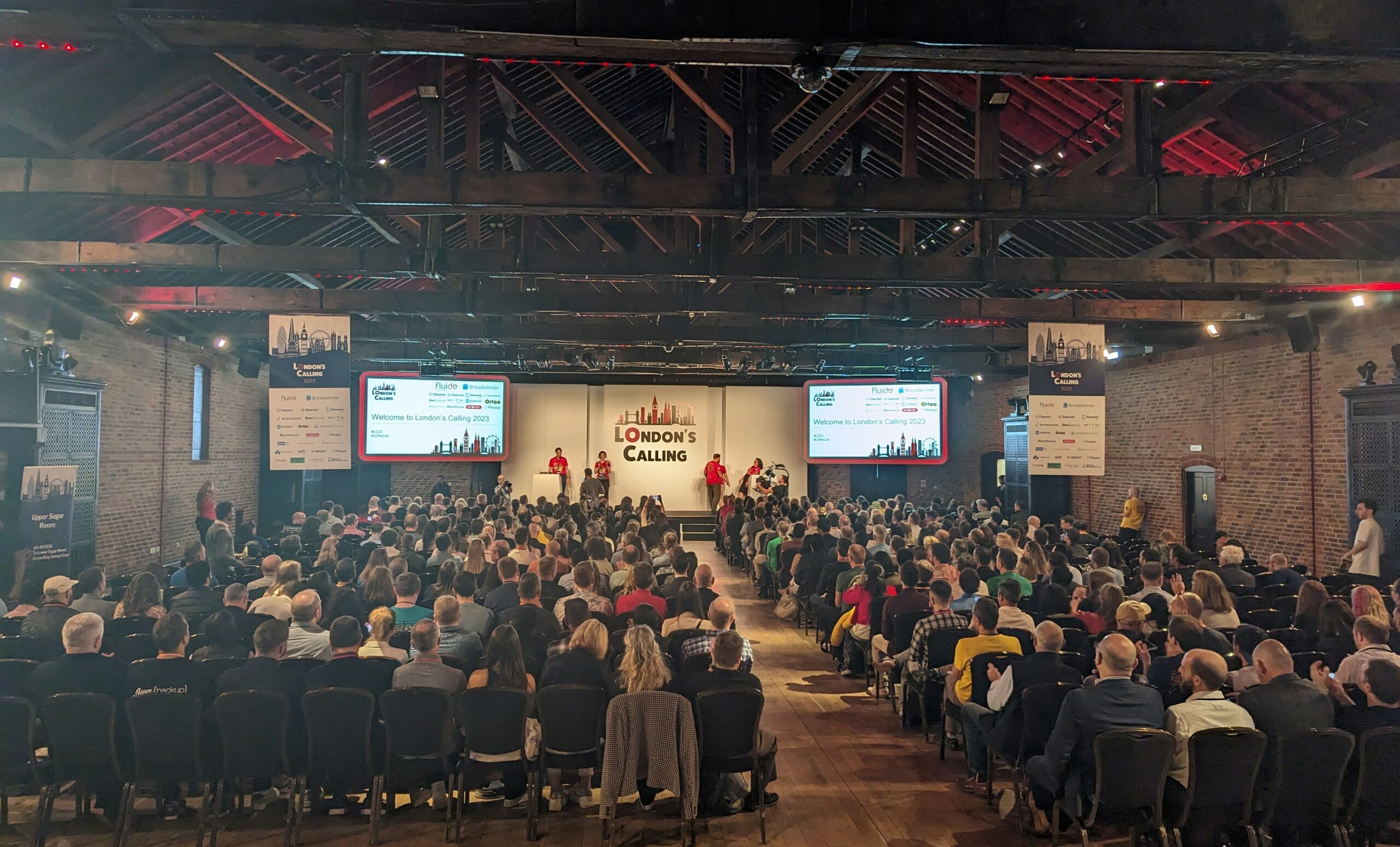
London’s calling for salesforce is a classic community conference with all the things that you don’t normally get in a vendor or marketing conference.
Initial impressions as someone attending it for their first time was that the conference was run by a long-time group of friends, 1 and gave off that warm community feel but still run professionally, and given that Salesforce is a still growing trend it was well catered for with all the freebies, everything from massages to good giveaways.
The Venue was excellent, helped by fantastic weather, but with obvious backups in case it all went rainy.
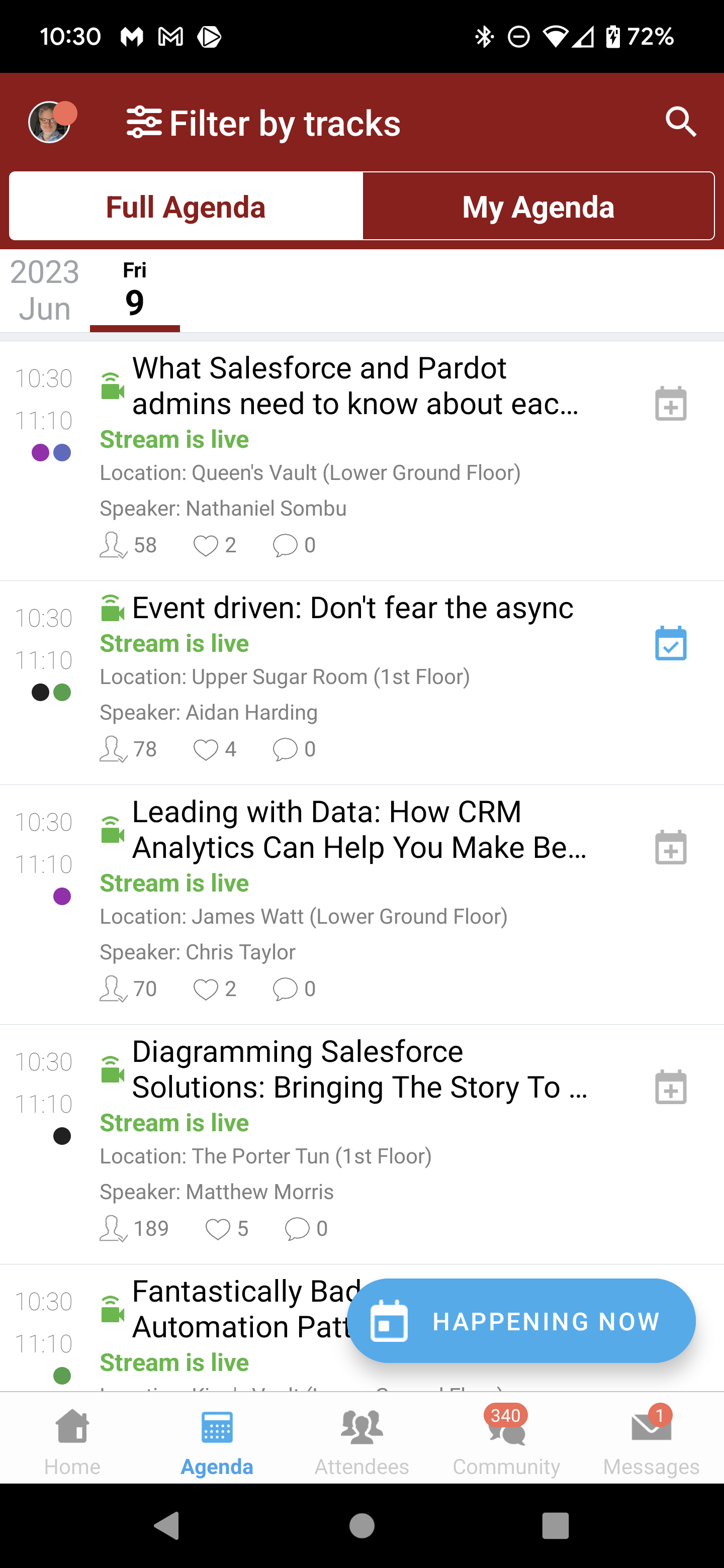
The content was far more what I like to see at a conference, with tons of deep dive content for the product and how to use and expand it. As you can see from the screenshot, there was loads of concurrent sessions going on and the vendor area was well placed because you go via it between sessions to grab a coffee.
The Vendor area its self was nicely laid out, and fit in well with the conference timetable giving you time when you needed it to have a good chunk of time to talk to a specific vendor.
There was a giant floor decoration of all the speakers in the main entrance, which was a nice touch
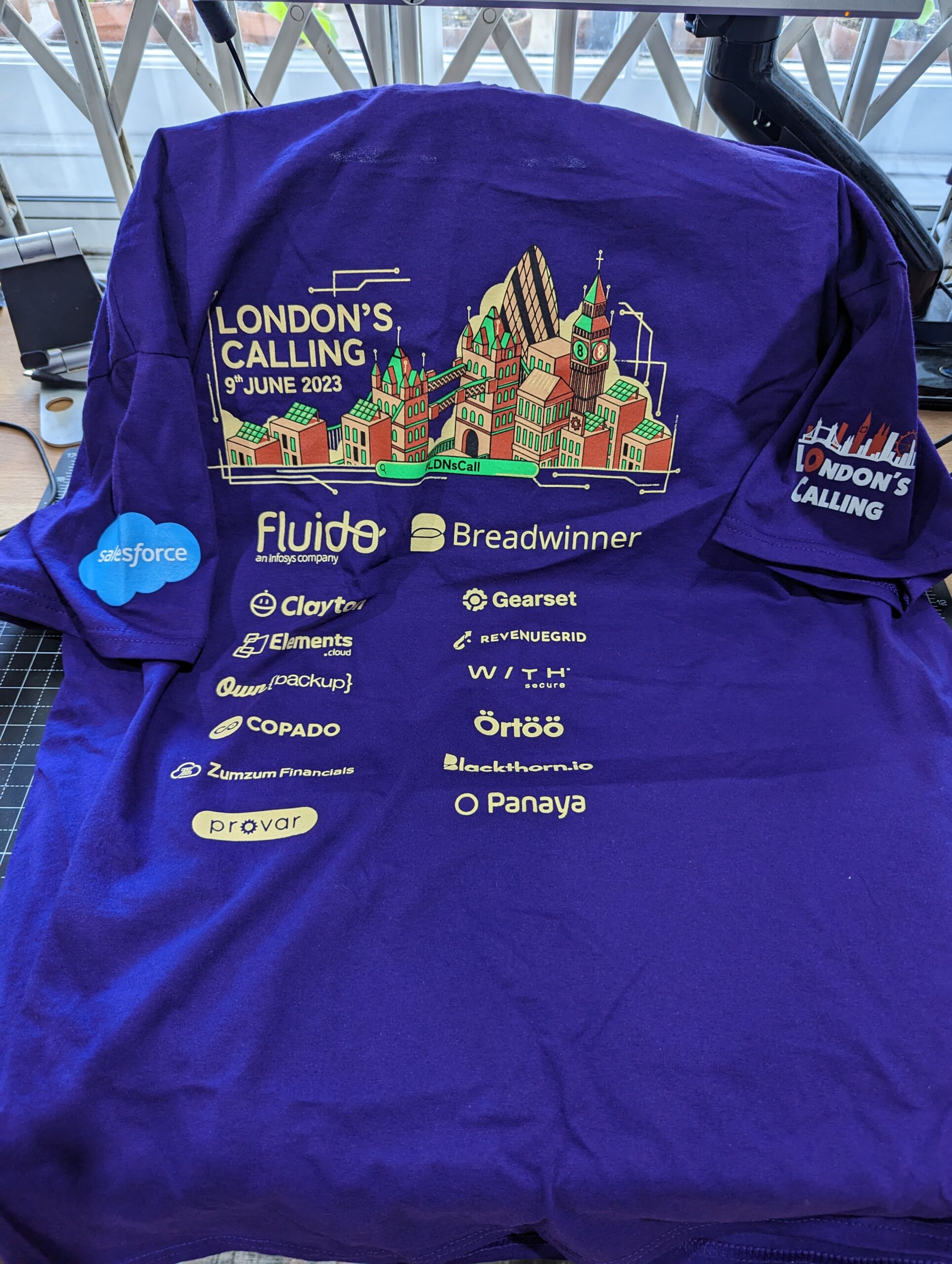
Good T-shirt Swag, solid make good art and slightly unusual (front)
Good T-shirt Swag, all Serious sponsors (Back)
You could not get your t-shirt till at least lunchtime. So you can’t run off early which is always a known problem when hosting an event inside a major metropolis that is full of interesting stuff.
The session content its self was slightly different to the other community conferences I go to, which are very very geeky with live coding, meaning you had to research before you even went to the session. This was far more accepting to people who didn’t know much about Salesforce or its community. I think the phrase to sum it up would be “No Click Code”, which seems to be a buzzword used by a number of the vendors.
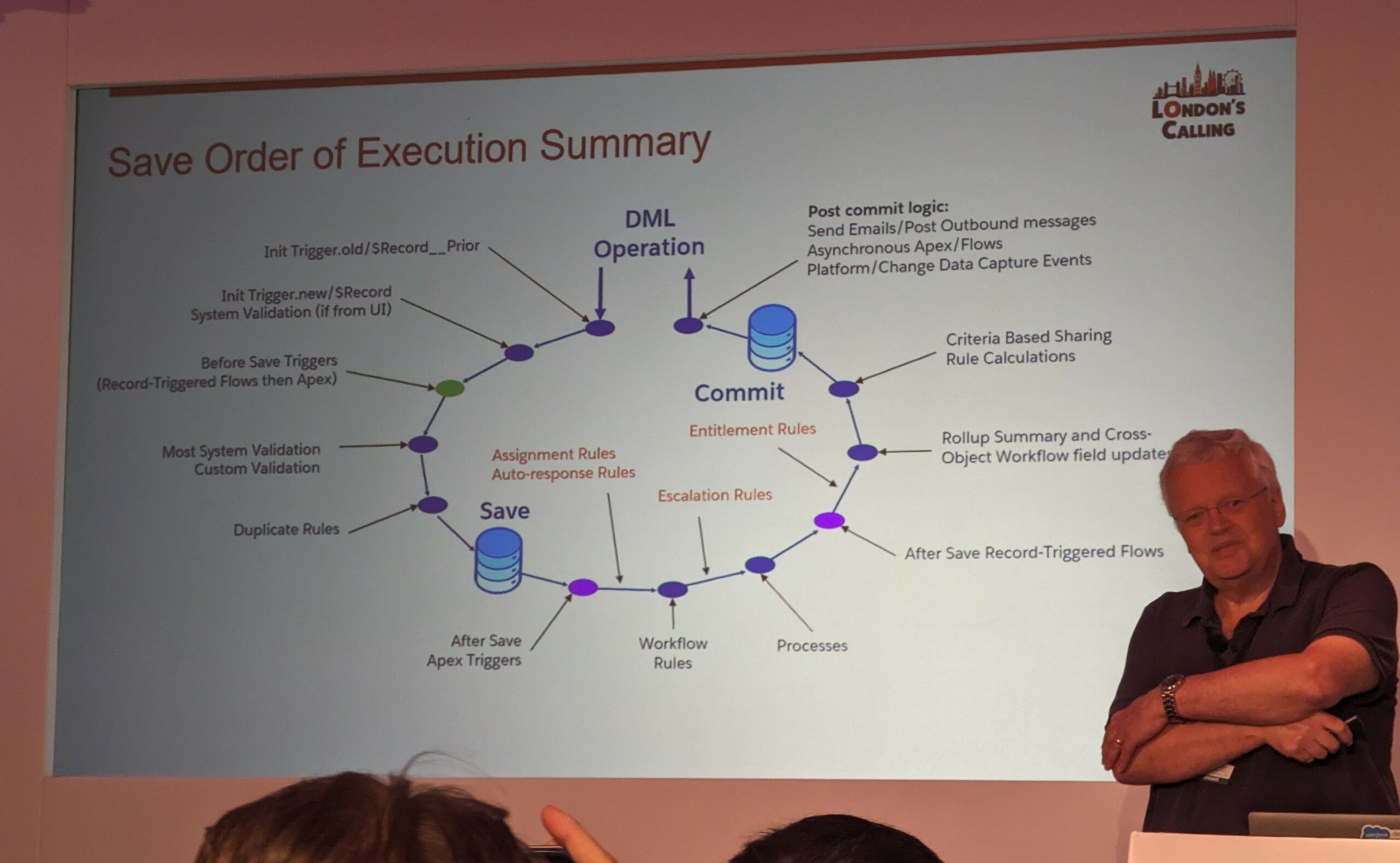
The best session of the day was “What happens when you click the Save button?” by Simon Connock, I would have killed for this lesson 5 years ago.
Personally, I do wish there was one channel available that you went to and did some really, really geeky stuff that was written by the pure devs, but I’m aware that that’s because that’s what I am. Everything else seemed to be catered for perfectly with good food and even an after conference party.
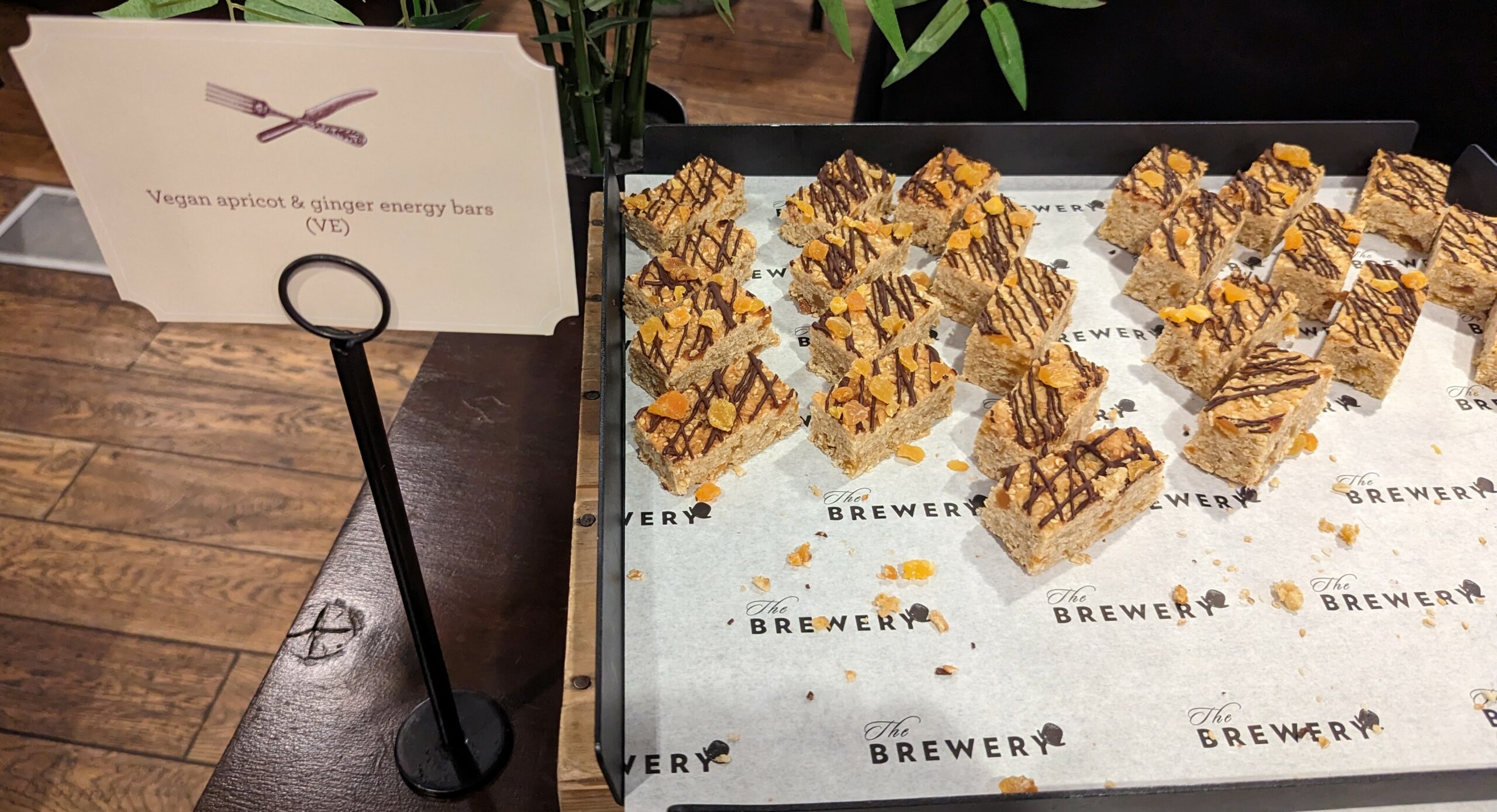
Now this is how you label snacks and Food at a conference.
Something that should be noted is they’ve managed to achieve near perfect diversity on genders in both attendees and presenters, far better than any of the big conferences or even previous communities ones, however they’ve done it, other conferences should be copying it.
Conclusion
Frankly I have not been shutting up about this conference to my colleagues that do salesforce, and will sure as hell be going next year as well as dragging multiple people with me, it is very much recommended.
Now you will forgive the slightly overdramatic nature of this title, but it’s something that had me practically jumping up and down during the main demo in the latest Salesforce conference, and it’s something that comes to light in every single AI Demo that I’ve seen.
And that is the use of AI when it comes to data in a demo verses a corporate environment or doing something serious. Ultimately the problem is data access. As Salesforce themselves have just said, “AI is only as good as the data”, and I’m not talking about Bias or AI hallucinations or any of that. I’m simply talking about large scale AI use in a corporate environment and the expectations of the business. AI has been sold as basically the solution to all things of life on Earth. but to give those kind of delivery’s all of your data has to be available to AI near Instantly, and all of IT know that is not the case.
let’s take the Salesforce demo as a perfect example. They were showing that AI had access to four different data sources, and it was using that access to construct the perfect interactions with customers and other humans. Brilliant. Perfect.. . But all of that data is already in Salesforce. AWS‘s demo was exactly the same. All of the vendors that are showing these beautiful AI’s using data are effectively doing it from local sources in modern formats and with high quality data. If we would move this back to our corporate environment , the sheer volume of legacy data that is scattered all over the place used in various different systems would initially make this impossible. if you don’t believe me, think of when you’re trying to merely do reports cross data sources and how much of a pain that it is. But we are not home to Impossible, so before selling AI to the business make sure you set the expectations and work out how you are going to get round current limitations
These Limitations are grounded in the following:
Interfaces: Lots of legacy data does not have standard interconnects and does not have standard API’s to get it all in one place, particularly in terms of real time access, sorting this out is additional cost and time on your integrations.
The underlying infrastructure: A lot of the legacy data you will be pulling in 1 will not work in the way you think it does. So if you’re thinking your AI will be able to access all data 24/7 then you are in for a shock. Some legacy systems will be down or slow for backups. Some legacy systems will be running at 80% or 90% of their utilisation because no one’s bought them bigger servers. Some systems will be suffering from their own heavy loads because of quarter and year end reports. These will mean that source systems are already under tremendous strain and you adding additional load is not going to make the business happy.
Data Transfer: There is also the matter of data transference and accountability. when feeding AI’s we will often be pulling data from all over the planet. that’s fine most of the time but you do have to be careful. The EU tends to only be bothered when you’re shovelling data outside of its borders. But there are countries that get really really hot and sweaty about moving data across borders. Italy and Turkey are two that leap to mind, and the German Workers Council is famously very fighty when it comes to moving peoples data around and exposing it in different ways. So that has to be handled. Some companies like Salesforce are aware of these problems. They made a big thing on their recent secure layer, but that secure layer is for data leaving salesforce not the other way round, be careful people, there be dragons!.
Syncing: While we are talking about moving data, don’t think you’re going get away with merely syncing data to a giant central repository. it can get huge and out of control very quickly, the costs can sky rocket and sooner or later an accountant is going to ask you to justify the reason you are maintaining the same data twice, Then you have then got the constant syncing to deal with, which in itself can trigger some of the points I mentioned above, and finally a lot of the legasy data stores do not maintain transactional logging, or even update logging. a feature needed for reliable syncing.
Cost: All this data pumping around for integration costs money and the nearer you want it to real time the more money it costs. Is the new AI features going to give you a good Return on investment or a competitive advantage?
Silo Owners: Lastly there are the owners of the current data sets, these source systems are often that person(s) career and job and they will fight tooth and nail to maintain control of it. thus introducing a political element in your deliverable that can get very messy.
Meta Data & Data Quality:2Mark Forster made the following wise addition:
I would add another issue to those described here, which is metadata management. Are all data used being described in the same way with rigourous and applicable ontologies? In many cases this is not true and data from different sources are described in different ways. Maybe it’s trivial in that the units differ (Kg Vs Stones). Maybe the same attributes are given different names. As always it must be cleaned to a high standard to achieve meaningful results.
I could not agree with this comment more and its why I spend so much time on the Insurance Dictionary, as data definitions and quality are a terrible plague on integrations.
And that’s it, this was merely a short rant. It’s not to say that AI is not going to produce all of the awesomeness for us that has been promised. But you’ve got to manage the business expectations on what it can do with the information you can get to it. And the core of that is to make sure it has all the data in a timely fashion, costed out, and confirmed on a legal side.
and I say this from decades of real life experience,[↩]
Edit: This entry was added after I cross posted to linkedin[↩]
This is when multiple stakeholders end up fighting over limited resources in a corporate environment.
Explanation:
This is a term used during those sporadic times in every corporation where budgets suddenly become tight, the reason makes no difference, every manager, director or stakeholder suddenly frantically scrabble around for every bit of budget, even pinching off each other, sometimes pillaging general usage pots and generally behaving in a very scrabbly way 1, but if you are watching it, it can look like the children’s game of the same name.
Disclaimer: As always these posts are not aimed at anyone client or employer and are just my personal observations over a lifetime of dealing with both management and frontline associates.
all for perfectly valid reasons, they’re just protecting their projects[↩]
Ever since I started in support some 20 odd years ago, I have always tried to carry a small toolkit with me, back then it was a very cheap one supplemented with Christmas presents for my dad who has always known a quality tool 1. Now it is custom built out of the very best bits and bobs that I know about.
This is my current carry. It’s a tiny bit on the heavy side for most ‘suits’ but then again I’m not a lightweight person. Let’s break it down 2:
Wera screwdrivers have long been my go to make, I’ve adored them for years. And they have reached their Pinnacle with the 8009 Zyklop ratchet screwdriver. 12 built in bits rather than the normal six. Beautiful quality all around , thoroughly recommended. I do however swap out two of the torx bits that they supply with two flat heads which are still used a lot. In addition on the photo, we have another Wera part, this is off another screwdriver and is just an extensionas you sometimes need a little more reach. Next we have a set of screwdriver adapters for Allen keys, the funny rounded heads on these are so you can use them slightly at an angle. strangely there is also a chuck adaptor for drill bits, I just seem to need it a lot and don’t like using proper drills in a number of places as a hand chuck gives a lot more control, for this I carry just one 5mm drill bit and a little bag for the various small parts. The missing items off here are sockets, the 8009 supports them but I just never seem to need them.
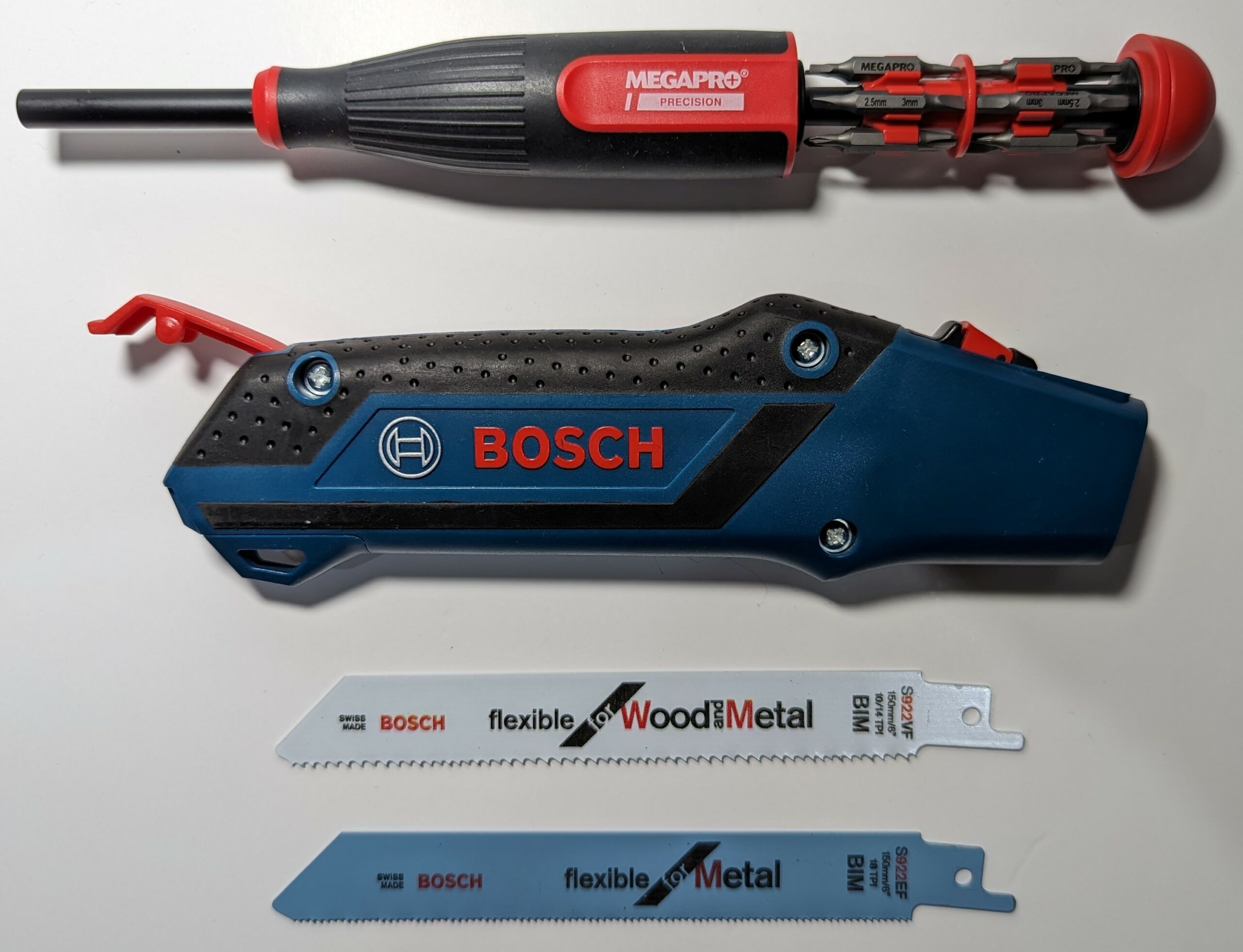
Next we have a precision screwdriver. There are lots of precision screwdrivers on the market but all seem to be designed to be desk bound, The Megapro one is the one that I’ve come to love. Not only does it have a good selection of bits inside which most precision screwdrivers don’t, because they’ve got a tiny useless handle, but as the bits are inside its a nice single unit. Next is a Bosch handsaw. Well it’s not really a handsaw. It’s just a handle, but it takes the standard blades meant for the big electrical reciprocating saws which are easy to get hold of and have different types of blades, I have found this a easy way of carrying around a small saw because the handle is hollow and can hold two blades. The construction feels a tiny bit flimsy but it’s held up to sawing through a variety of things so far, so I’ve got no objection.
These are reverse tweezers, they default to closed rather than open meaning they can free up a hand and they work just as well as ordinary tweezers. Also because they’re held close by default, you don’t have to keep something on the end to protect the tip so they don’t get damaged or bent out to place.
Now you wouldn’t think you’d need a spirit level but I seem to 3, This one is a free one that comes with big Dell monitors.
Next is one of the nicest little torches I have ever met, Yes I’m aware that we all have torches in our phones, but quite frankly, battery life is a serious thing and sometimes it’s good to have a good torch that won’t overheat. This one is well constructed. It’s USB rechargeable, and you can also swap out the built-in lithium battery for 2 x AAA’s in case you run out.
Next are a pair of Knipex Cobra® XS Water Pump Pliers, they double up as spanner and pliers for me, they are tiny but you would not believe how strong they are. If you doing electrical or electronic things in server rooms or with computers and you need more grip than this pair of pliers can give then you’re doing something wrong in my opinion. They are apparently used by all of the small toolkit people and I can understand why.
Japanese micro snips, I don’t know why Japanese but these kind of very small cutters from Japan seem universally good. I originally bought them for modelling but now use them for everything. They’re obviously smaller than a proper pair of wire cutters but they take up less space, and for the stuff I’m doing I don’t need any more. Obviously they won’t handle things like a nail or something really serious. But again, I am not doing large scale construction.
And the last tool is a folding Stanley Knife, it’s not something you tend to carry around in public, but a main stay of every tool kit, this one as normal, carries a couple of spare blades and is rock solid.
All of these go in a little bag. I know that some people like all the foldout/fancy ones, but quite frankly, who has time for that. A decent indestructible bag works for me and I’ve ever found better than the Magma three pocket set. it just fits hand tools nicely.
There you go, my odd little portable tool kit.
being both a professional electrician and an amateur carpenter[↩]
This kit isn’t my absolute de facto kit. my day to day tools I use at home are not so compact. My go to screwdriver at home is a gigantic Stanley ratchet one and I have for the last 10 years been using a lovely set of precision screwdrivers that my dad bought me. In fact most of my home tools are ones bought by him at some point and they are both excellent quality and hold good memories but this is the custom kit I have built for travel[↩]