Going to ILUG and taking my better half

I will be going to ILUG in November and so will my wife, along with @HughsterRooster wife, @mattwhite girlfriend, and many other better half’s

why is this?, are they keeping an eye on us?…Nope!

Is it because ILUG is in a memorable historical location that has tons to do and try?, is it because of the advantages room rates?, or the fact its basically a holiday location?…nope Nope NOPE!!

Its because the best people in the lotus world will be there and its not a “conference” in the old fashioned sense, yes there are amazing speakers, tons to learn, corporate sponsors, stuff to take back to your client/employer, the chance of free beer and me trying to force grain alcohol down your throat while ranting at you but its not TOO geeky and very defiantly not too corporate. humans are welcome.

And that’s the point, its not a thing to get a “pass” to, its a thing to treat your family to while getting tons out of for your self, my main client wont pay for it, and I don’t care, on the flight back I will sit back, brain and belly full with a clear conscience.

ILUG, its not going to be a guilty pleasure, its going to be pure pleasure.

Vegan Survival Rations

As those who have to deal with me on a daily basis will tell you, I have a thing (bordering on an obsession) for little “packs” of stuff. One item I have been searching for for ages is a compact food pack that I can just leave in the bottom of my rucksack that would hold me or a loved one for 24 hours. All the ones I have found so far have been army packs, which are designed for living on for months and are huge or energy bars which ain’t filling and don’t have a balanced content. Added to this is the need for it to be vegan/vegetarian. A couple of days ago I found Seven OceanS standard Emergency Rations , which only those who have been unfortunate enough to be trapped in a lifeboat will have come across. They seemed perfect, so I ordered some, and opened a pack (as there doesn’t seem to be a review or proper details anywhere)

They come in a very traditional cardboard box, which contains a vacuum foil pack,

Open up the foil pack (it says you can rip it, but I had to bite it) and you find 9 grease proof “bars” wrapped in plastic

Each bar contains 2 biscuits, the biscuits taste vaguely sweet (sort of about the level of a digestive biscuit), they have the consistency of shortbread, I could quite happily eat them on their own, but they would equally go with most things from peanut butter to baked beans. My better half also tried them and said they were good.

The makers website does not contain much actual detail so I include the nutrition facts from off the box

All in all they are just right for my needs, an additional and far more practical use they could be put to is for the vegan/veggie lot, sometimes they are placed in a situation where you find very little suitable food to eat when travelling, and it would cost nothing to keep a pack in your luggage (my better half says they would make great vegan shortbread when there is only black coffee in the morning). It would be nice if the box had “once opened” instructions. The fact that they are low cost, about £5 for 9 bars (2500 calories) and have a shelf life of 5 years are excellent bonuses.

MyEclipse for spring 8.6 and good customer service

For those of us who use the rather pleasant MyEclipse IDE (a commercial version of the Eclipse IDE as recommended by Matt White) and in particular “MyEclipse for Spring” we all have been waiting for their 8.6 update to take a look at the new MVC scaffolding feature which gives a comparable feature set to Spring Roo (basically giving the auto code generating and framework building that i remember people calling RAD, but without requiring a dedicated platform such as Domino),.

Anyway I installed the update which promptly broke my IDE in a major way, with it refusing to start and giving a

java.lang.RuntimeException: No application id has been found

error, which in the end turned out to be caused by my flash builder 4 plug-in, ah!, a bit of fiddling and i got it working again, but still it was not a happy ferret, so i just rolled back the VMWare image it lives on and continued as normal,

why is this noteworthy?

Well as i have had such success the powermonkey lot I thought a quick tweet to @skywaysoftware, would do no harm, quick as a flash I got a request from them for the error message and if possible the log, i sent the error message, and within a few hours the following link was sent to me: here, the full text is below

“For those with MyEclipse for Spring 8.5 who have the Adobe Flash Builder plug-in installed, there is an issue when upgrading to MyEclipse for Spring 8.6 that will prevent the IDE from restarting. It can be both avoided (and corrected) by removing the com.adobe.flexbuilder.feature.core.nl1.link from the dropins folder.

If you are upgrading, remove the file before starting ME4S, then perform the 8.5 to 8.6 upgrade. After that is complete, shut down ME4S, re-add the Adobe file, and restart.

If you have upgraded and ME4S won’t start, remove the Adobe drop-in, start ME4S, then stop and re-add the drop-in.”

A nice useable work round, while they sort the problem out, and one that works,it didn’t cost them much and kept me as a loyal customer,

LEARN BIG BUSINESS, LEARN!!!!

Now I’m up and going again, prepare for a review of MVC scaffolding Vs Spring Roo Vs Traditional Rad (in a few days).

A Java Application Infrastructure

The cloud is a big thing nowadays but there are still times when you need to build your own infrastructure to host a large Java application, it needs to be bomb proof but still not cost the earth and grow smoothly at need, such a situation has recently arisen for a client, and while i was putting it together i was luckily enough to chat with application architect for VMware, taking into consideration the tips he added, I put forward the following design, i hope its of use to someone else:

Icons Key for diagrams

This represents a dedicated Apache box used for load balancing, and it forwards requests to the main app servers. This server requires very very little by way of disk storage.


This represents a dedicated JBoss application server. It also has a read-only version of the main MySQL database so all SELECT statements can be run locally.


This represents a logical SQL server, the master database for the application. Its platform will vary as the application grows from a stand-alone database to a multi-master cluster. It is the only database in the system that is written to by the application.


Dashed links indicate when a change is committed to user data. Updates aren’t written to the local database on each application server, but written back to the master database.


Dotted links indicate when updates to the “slave” databases from the “master”. The master database is responsible for ensuring that the slaves are kept up-to-date.


Blue links indicate servers that are sharing user session states, which means users will not lose anything should we have an application server outage.
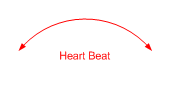

Red links are the “heart beat” links that the load balancers are monitoring. If the current load balancing server stops responding (per its heart beat) then the backup will pick up its duties (as well as taking over the live IP address).

Phase 1 (Development / test)

This is the most basic configuration, with two application servers sharing user session states (one load balancing).The development and test environments will be set up like this.

Phase 2 (Minimal live)

A basic live environment; this removes the single point of failure on load balancing. You will have to decide as to the format of the logical SQL Master (i.e. whether “Enterprise” or “Cluster”). At this stage you will need to do full load tests (to failure) and decide if it will meets your needs if a phase 3 set-up is required for go-live.

Phase 3 (Mid-range live)
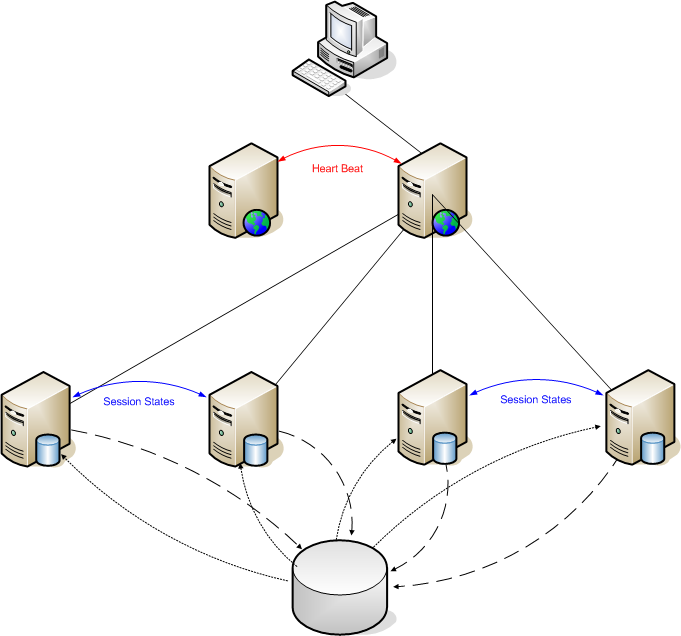

This phase includes the addition of two more App servers. These do not share session states with the initial pair in order to limit the chance of a cascade failure. At this point the option of a delayed read slave for the master database server should be raised as this provides an excellent option to rectify large data corruptions without the need to resort to a full restore.

Phase 4 (Enterprise level)
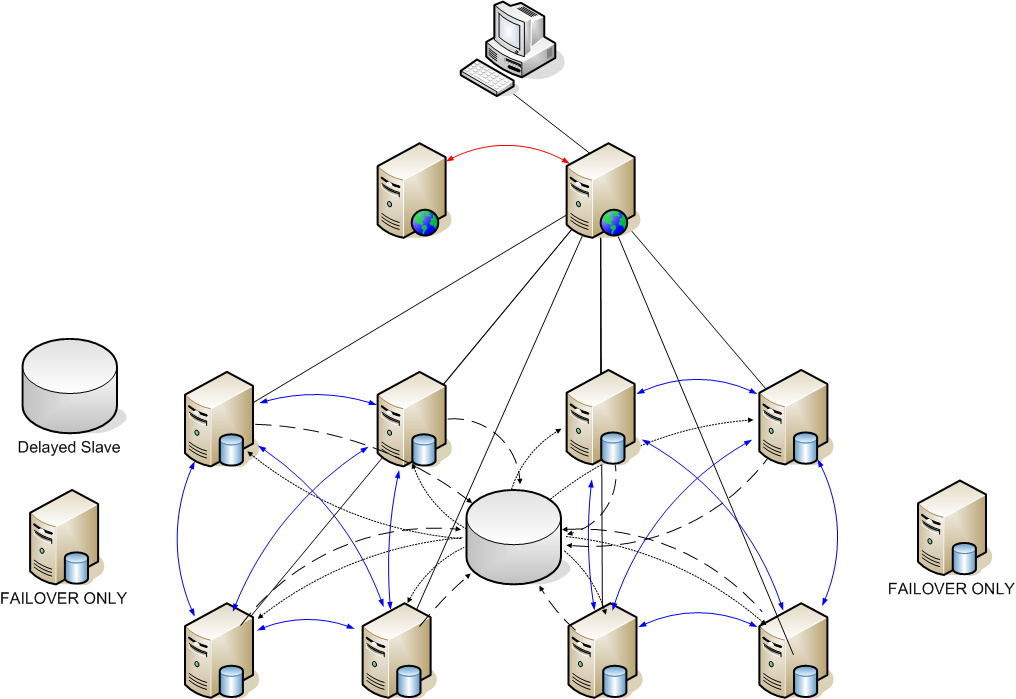

Classed as a “fully populated” stage. Beyond this architecture, a dedicated load balancing system (hardware) would be required, distributing the application over multiple data centres, or move to a cloud-based infrastructure.
This phase comprises two groups of four servers sharing their user sessions, with two fail-over servers to mitigate cascade failure. The master database is also clustered, and a delayed-read slave become necessary.

give me a yell if you want LDC to build this for you (or even more fun a app that would need it 🙂 )

Its good to help clients

The following quote was in a clients internal quarterly director’s update on the subject of Client Wins:

“Winning this lead confirms **** as a major player in the US airline market. The aviation team cited the new Claims Online tracking system, as well as ” … “as some of the key reasons for this win.”

I and Mark Barton wrote the system and its really nice to make a difference to a companies bottom line, this will be the third big difference I helped make during my time at my current main client, it feels good, after all even contractors have pride in their work 🙂 .