
Management Tip: Try To Get Your Delivery Dates Out of Sync with Other Projects.

A sneaky little tip for project managers is to try to move your project delivery times to be out of sync with the usual delivery patterns for your organisation.

Most projects tend to aim for the same delivery date, often tied to the end of a large corporation’s financial year, usually December. That seems sensible enough on paper, but in practice, it causes a predictable pain.

In today’s service-oriented infrastructures, where there’s a shared pool of resources, budgets, and dependencies, any delay in one project tends to ripple across the lot. As a result, all the deliveries bunch up at the same time. That’s fine; because as managers and architects we are paid to deal with that kind of thing, but what we often forget is that everyone else is paid to do the same thing at the same time.

The outcome? The last few months of any given financial year are pure mayhem. Every team wants extra time, extra effort, and extra support from all the shared support teams to push their project over the line. Everyone’s pulling on the same people and systems at once.

If I had my way and could get involved right at a project’s inception, I’d always try to schedule its delivery for a quieter time of year, when other projects aren’t all competing for the same shared effort. It’s a small adjustment that I find makes a huge difference to delivery quality, stress levels, and overall sanity in your teams.

Priority Without Consequence in Projects

When you are running any form of migration, integration, upgrade, or indeed any project that touches a live business process, there will always be a battle between BAU 1 and the project. This battle can be over resources, vendor time, budget, or even something as core as system uptime. Inevitably, there will be a debate about who gets their stuff first.

The default position is usually that BAU takes precedence. A production issue always wins against everything else. However, if you are managing either BAU or the project, you must remember that every priority comes with a consequence. This is the part that often gets overlooked.

For example, a BAU team might say, “We’ve got a production issue, we need the developers to drop everything,” or “We need to cancel the weekend outage because we have to work through it.” It makes no difference what the specific request is. The key point is that even when one side’s priority is accepted, it is often assumed by that side that there will be no consequence or no cost for exercising that priority.

When this happens, you will often need to have the awkward but necessary conversation: “Yes, we’ll all pile into the BAU problem, but this will have the following knock-on effects.” I would strongly advise anyone running projects to be crystal clear on this at the time. People have very short memories about these things, and later you will hear questions such as “Why is your project late?” or “Why has BAU been impacted?” Without a proper paper trail, it becomes very hard to justify the outcome.

So when you have a situation where one side’s work must take priority, acknowledge it, accept it, and then record the consequence. Provide a bill, whether that is measured in lost time, extra budget, or a revised delivery date. It is the only way to maintain fairness and transparency between BAU and project work.

  1. Business as usual []

Finding an Alternative to Play.ht for Your Text-to-Speech

Well, it turns out that Play.ht has gone bankrupt.

I hadn’t seen any news about it, so when I came to do my latest blog post, I found the site was down with no indication of support, no notice, and no email. A bit disappointing, but there you go. The internet gives, and the internet takes away.

That still left me with a problem. I need a decent text-to-speech converter. I use one both to ensure all my blog posts have an audio version and because, as someone who is badly dyslexic, I find it the best way of proofreading my work. Listening to my posts read aloud helps me spot those moments when I think, What on earth is that? and correct my gibbering.

So, I had a good trawl around with a specific set of requirements. What I wanted was something where I could paste my blog text, have it follow punctuation properly, let me listen and review easily, work quickly, and not cost a fortune.

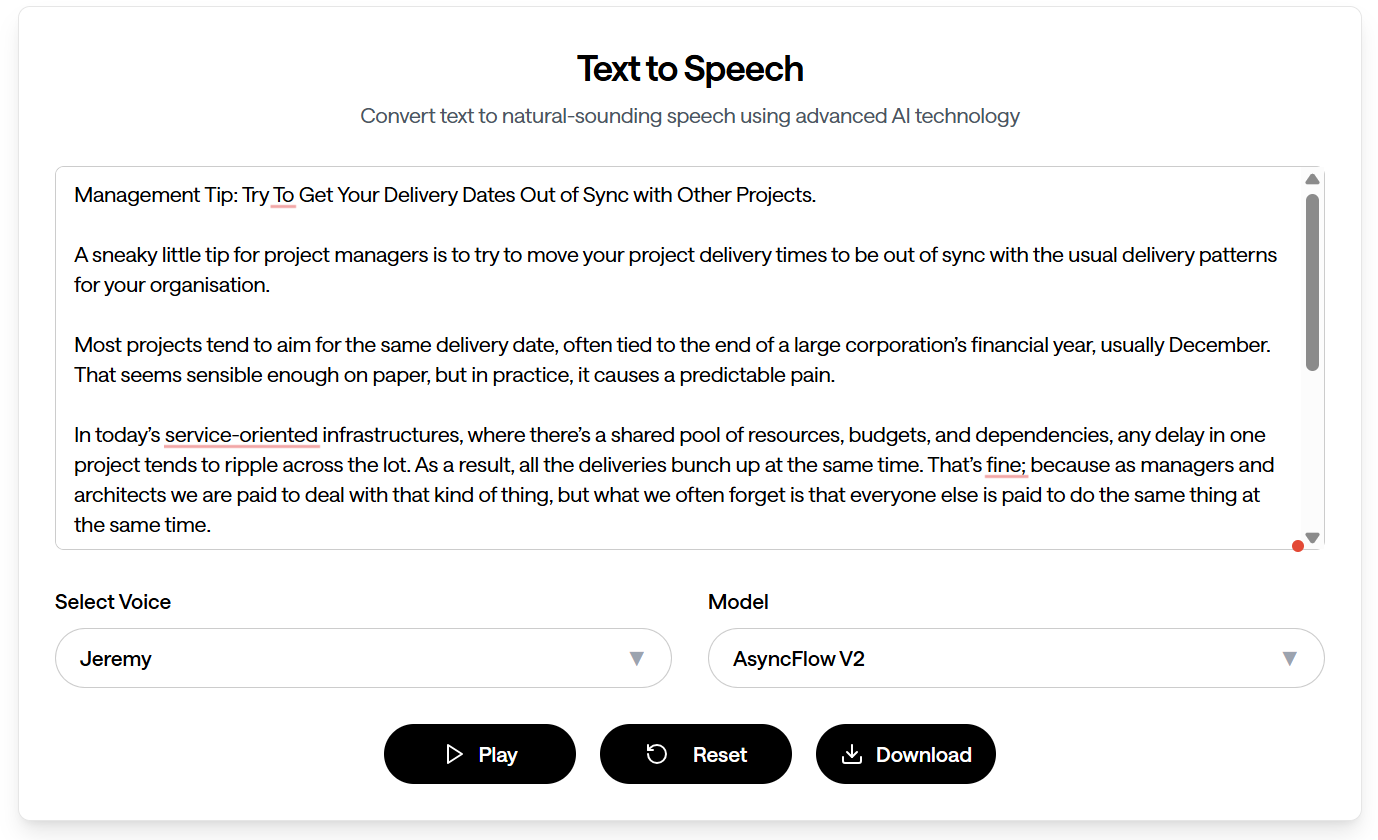
After a fair bit of digging (and trying a few others I won’t name and shame), I ended up with Async.ai, which met all my needs. It has an easy login, a simple text-to-speech interface with a large input box, sensible formatting, and a solid range of voices and styles to choose from. It generates speech far faster than Play.ht ever did, and you can download the output as a WAV file. I then convert that to MP3 and upload it as a media file on my blog.

I have no interest in having the audio hosted elsewhere. That lesson has already been learnt with Play.ht: don’t trust anything other than your own website.

So far, I’ve found that Async.ai works well. The voices sound good and natural, and it feels very similar to what I was using before. I’ve subscribed, and it’s much much cheaper than Play.ht or many of the other options, with a simple pay-per-hour model that suits me perfectly.

My only minor irritation is that when you click Generate and Play, you can’t skip around easily. Every time you fix an error or tweak some grammar, you have to listen to the whole post again. But honestly, that’s a small price to pay for such a straightforward, reliable setup.

If you’re moving away from Play.ht, or just looking for something new to convert long-form text into speech, I’d recommend giving Async.ai a try.

Integration Support Challenges in Production

Now this is an incredibly dull subject, but one that many companies continue to struggle with when it comes to integrations.

All integrations, by their very nature, are quite brittle processes.

They often involve converting data from one format to another, and because they cross multiple systems and ownership boundaries, they can be difficult to pin down when things go wrong.

Many of the endpoint systems that are integrated into have very restrictive support models, and security rules often mean that each team can see only a limited part of the picture.

So, once the project work has been completed and everything is technically “working,” as it should, then the real challenge begins, which is how do you actually support it in the long term?

Of course there will be issues around monitoring, workflow, ownership, and escalation paths, but ultimately it comes down to one thing:

Responsibility.

People rarely want to follow a formal process that leads to them having to pay for it to be fixed. Instead, you’ll hear, “Oh, X is broken, call Y.”

It’s human nature, and integrations tend to encourage this kind of finger-pointing.

“It’s your bit that’s broken, not mine.”

The best tip I’ve found for handling this is to ask a very simple question…

Is this a new piece of code, a new application, or a new machine? If so, who are you paying to look after it?

That’s the crux of the matter. If there’s no budget, then most departments will quite rightly say, “That’s not our responsibility,” unless it’s a simple configuration change or something that clearly falls within their existing remit.

But integrations rarely work like that.

They almost always introduce new code, new objects, or new dependencies.

So, the next time you’re trying to work out who owns a piece of integration work, just follow the money.

Whoever is being paid to maintain it is responsible for it. If no one is, then you haven’t yet found an owner. And if someone is willing to take the funding or resources, then they are, by definition, the right people to make responsible.

It’s a simple question, but it saves a lot of pain.