A Healthier Alternative: Finding the Right Energy Drink for Long-Term Wellness

For those familiar with my past posts, you’ll know I’ve been engaged in a long-running search for a reliable, effective, and healthier energy drink. The goal has always been the same: to find a product that provides a genuine energy boost without triggering any long-term health issues caused by overdosing on B6 vitamins, apparently this is particularly an issue for those of us over the age of 40.

Over the years, I’ve trialed a wide range of options: from powdered “gamer” formulas carbonated with a SodaStream, through all the “natural” energy products, to every mainstream energy drink on the market. My motivation? To avoid relying on Red Bull and its many imitators.

Revisiting Brite.

Among the many products I’ve tested, Brite stands out as one I’ve returned to repeatedly. It has undergone various iterations over time, from an unappealing but effective green formula prone to spoilage, to its current lightly carbonated canned form. While the newer versions aren’t my favourite in terms of taste, 1 they do have all the right ingredients and do the job nicely.

This return to Brite coincided with my wife reviewing the nutritional content of the energy drinks that she found in our cupboards. Her findings highlighted some serious concerns regarding long-term health risks, particularly the neurological ones associated with frequent consumption, especially in older individuals. This prompted a renewed focus on finding a safer, cleaner solution.

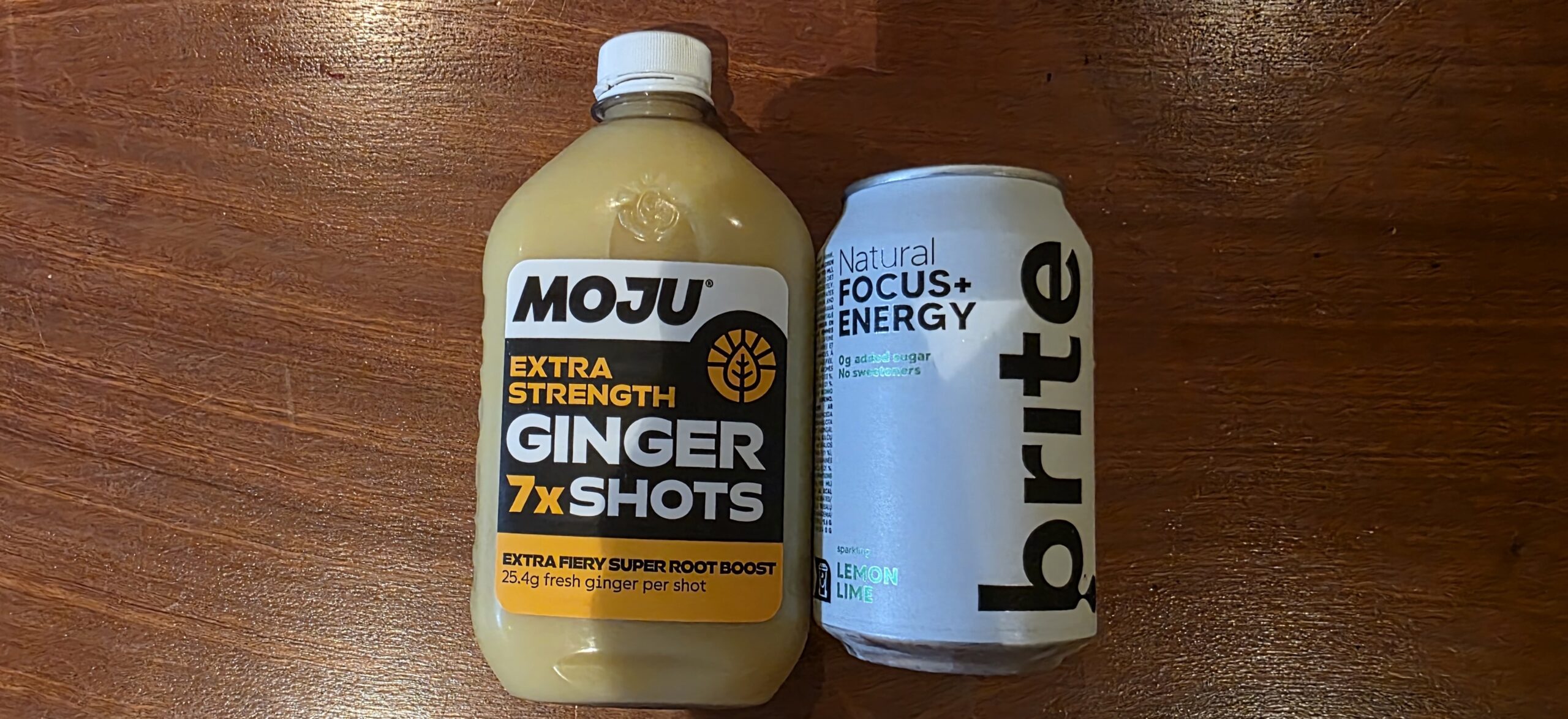
Prior to this I had been drinking a mix of MOJO’s Extra Ginger shot and Wrath’s performance formula. While effective, the wrath powder ingredients did not bring joy to my better half’s life.

Eventually, I found an effective compromise: a combination of Brite (lemon & lime or raspberry flavours taste best in my opinion) with a shot of Extra Ginger from MOJO. This blend delivers a clean, sustained energy boost with the added benefits and taste of ginger.

Why This cocktail Works for me

  • The non-synthetic caffeine and matcha content delivers alertness without being hyper.
  • The Ginger adds natural anti-inflammatory effects (good for the guts of an old man) and a sharp, refreshing taste, which helps replace the need for tonnes of sugar.
  • Both Bright’s and MOJO’s formulations are relatively organic and free from synthetic components
  • Both companies do a good subscription service that provides a discount
  • It just tastes good and wakes me up.

While it’s slightly more expensive than typical off-the-shelf options (such as lower-end supermarket brands), the increased cost is justified by its higher-quality ingredients and reduced health risk.

  1. something that can’t be helped given the much lower sugar content,[]

Finding Your Work Threshold: The Key to Real Work-Life Balance


We all have limits, a certain number of hours in a week that we can devote to intense work or other high-effort activities. This “effort threshold” differs from person to person, but understanding your own threshold is crucial for maintaining a healthy work-life balance.

Why Know Your Limits?

By figuring out how many productive hours you can reliably sustain each week, you can plan your schedule, both work and leisure, without burning out. This concept applies holistically across your entire life, not just your job. For instance, if you love sports or have a demanding hobby, those hours count toward your overall “effort load.”

Personal Effort Threshold

To show you what I mean, here are my own effort levels which I have discovered through a somewhat obsessive level of record-keeping over the years:

Consistent Level: 77 hours of effort per week

This is the amount of time I can devote to various tasks week after week, month after month, without feeling overwhelmed be they Work, Sports, Hobbies or Housework.

Surge Level: 85 hours per week

For one to three months, I can sustain a slightly higher workload.

Sprint Level: 100+ hours per week

This is the maximum effort I can push for about two to three weeks before I need to scale back.

Because I keep detailed logs of my time, mainly for client work and personal accountability, I’ve been able to pinpoint exactly what these levels are for me. Everyone’s threshold will be different, but knowing your own is a game changer for work and life in general.

How to Find Your Effort Threshold

Track Your Time

Keep a detailed record of how you spend your hours for at least a few weeks. Use a journal, a spreadsheet, or a time-tracking app, whatever feels most natural.
Identify Patterns

Look for when you feel most productive and when you start to feel drained. Pay attention to both work and personal commitments (like hobbies, exercise, social events).

Set Realistic Boundaries

Once you identify a comfortable range of hours for each week, adjust your schedule accordingly. This might involve saying “no” to certain commitments or scaling back to ensure you don’t exceed your personal limit.

Account for Variety

Remember that a hobby or exercise might still demand energy, even if it’s a mental break from your job. Factor this in when tallying your total effort hours each week.

Adapting to Your Own Limits

It’s normal to underestimate or overestimate how much you can do. Often, we think we can keep sprinting forever, until we can’t. Recognise when you’re in a “surge” period versus a “sprint” period, and when it’s best to stick to your consistent level to avoid exhaustion.

Some of these adjustments can be tough. You may have to let go of certain tasks or delegate more. But ultimately, prioritising your health and well-being is the best long-term strategy.

The Bottom Line

If you ever find yourself exhausted and out of time, it could be that you’ve simply exceeded your personal effort threshold. The key to maintaining work-life balance is knowing how many hours you truly have to “spend” each week, and then consciously choosing how to allocate them.

Put another way: Work out how many effort hours you have, and fit your life within those hours. Doing so will help you stay productive, fulfilled, and far less prone to exhaustion .

My one thought piece on AI


This is going to be my one post on the place of AI and my opinions on how we are handling it in business and life.

AI. It’s been the big talking point for the last year or so and is still a front page topic. is it going to take all our jobs, spark a revolution, or create new opportunities? At first glance, AI does look like another seismic shift akin to the sewing machine, mechanised loom, or Ford’s production line. But there’s something fundamentally different about this wave.

Unlike past revolutions, AI doesn’t seem primed to create jobs at scale. It won’t spawn entirely new industries in the same way we’ve seen before. Instead, we’re likely looking at significant genuine job losses, particularly among lower-level white-collar roles.

In the Short-term, we’ll see disruptions as many companies will eagerly adopt AI to reduce costs and boost productivity quickly. But that’s where things get tricky as in doing that a certain way, you strip the long term growth out of your own company.

Lets take my own career as a technical PM. My effectiveness in this role comes directly from the breadth of my experience, having worked my way up through the lower level roles that AI now threatens. When I meet fellow managers lacking that foundational experience, their narrow perspectives are glaringly obvious. They struggle because they lack the hands-on knowledge gained from climbing the career ladder step by step.

If we let AI sweep away lower-end roles entirely, the future leaders and decision-makers won’t just lack depth; they’ll be missing the creative problem-solving skills developed by working through small, varied challenges. AI excels at averaging human outputs, but brilliance and breakthroughs often come from the “odd ones out,” those uniquely creative individuals whose careers and ideas evolve slowly over time.

Companies adopting wholesale AI driven job cuts might thrive briefly, lowering costs and increasing productivity, but will inevitably pay a steep price down the road. In five to ten years, we’ll experience a severe creativity and skill gap, causing real damage.

So what should sane businesses do instead? Integrate AI subtly and strategically. Take insurance claims, for example. AI excels at quickly identifying suspicious claims, far better than most humans on first initial checks, which means claim handlers don’t waste so much time sifting through genuine claims and can concentrate on the ones with a higher probability of being fraudulent. Leveraging AI in such a supportive way, rather than broadly replacing roles, allows businesses to boost efficiency without sacrificing human development.

This issue is particularly stark in creative industries. Jobs like artists, video editors, and audio engineers may seem like a good idea to replace with AI as it can theoretically turn an inexact set of processes into ones that can be managed precisely. But losing these foundational roles to AI doesn’t merely eliminate positions; it stifles future creativity. Rebuilding lost creative foundations is far more challenging than retraining white-collar workers. So, personally, while I use AI to eliminate tedious tasks,

I consciously avoid AI-generated creative content. Supporting human creativity, rather than replacing it, is critical.

How, then, do we roll with integrating with AI as individuals? I think back to my first corporate role during university placement, at the dawn of outsourcing to the Indian subcontinent. Everyone worried about job security. but a network technician named Richard Nixon told me simply: “Make sure you’re worth your money.” and that is how we should look at ourselves.

AI isn’t free, it’s a business tool, and companies providing AI will profit significantly. But AI has inherent limitations. The key is identifying human-specific strengths, intuition, flexibility, emotional intelligence, nuanced communication, and emphasising those. Managers seeking immediate cost savings might underestimate these qualities initially, but they’ll soon miss the critical human elements that AI can’t replicate 1.

AI, despite its capabilities, struggles to navigate human subtleties: body language, tone, persuasion, and ethical gray areas. These interactions are precisely where humans excel and prove their irreplaceable value.

Ultimately, AI is a remarkable tool, indeed it could be one of the greatest tools humanity ever creates, and if used thoughtfully, it will enhance human capabilities massively. But if handled recklessly, focusing solely on short-term gains, the long-term costs could be a right cluster f**k.

  1. Well not currently[]

Information Security Solutions 1st Tuesday Club – June 2025

Every time I attend the First Tuesday Club, I find myself wondering why I don’t make it a monthly priority. With ever-flowing drinks, fantastic food, and great company, it’s genuinely puzzling that it isn’t permanently fixed in my diary. But such is the nature of the corporate frenzy; we often take such opportunities for granted.

I found the atmosphere as welcoming as ever. The gathering typically hosts around 80 to 100 attendees, a solid mix of familiar faces and new introductions. It’s always nice catching up, exchanging insights, and sharing anecdotes, particularly about the ongoing adventures in the security field. This night is one of those rare places where professionals can relax, share openly 1, and feel genuinely supported amidst the relentless security battles we all face.

Mr. and Mrs. Sutherland were there as always, a consistent presence over many years, this time introducing their daughter, a fab moment that made me feel somewhat ancient but also hopeful seeing a new generation stepping forward. As always, the evening featured a fantastic spread, perfectly balancing a comfortable atmosphere with just enough corporate sponsorship to ensure everything was covered.

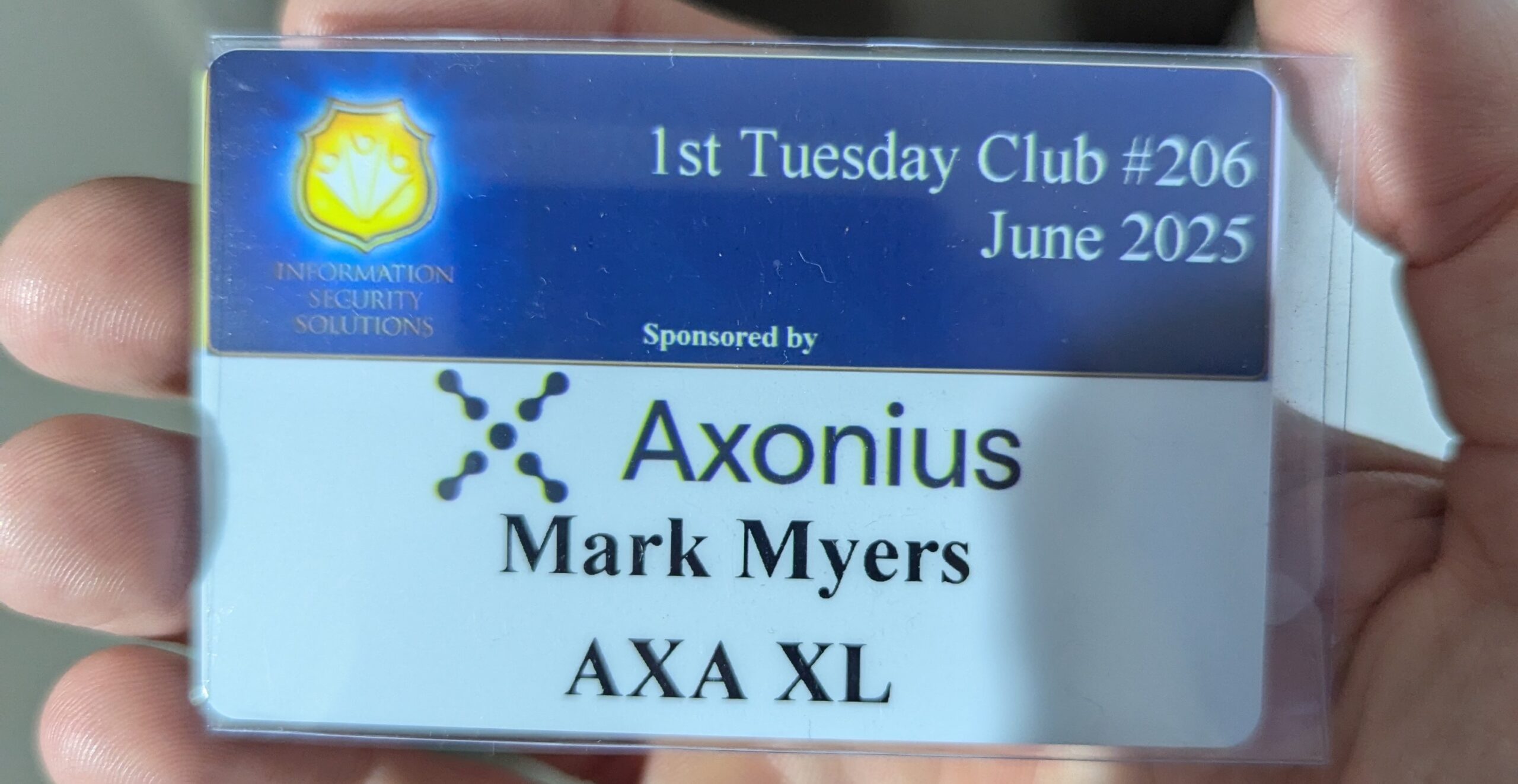
This particular event was sponsored by Axonius , an impressive company whose services seem like an excellent fit for one of my clients. I had an interesting and no-pressure conversation with one of their team members. Rather than heavy-handed selling, the representatives casually mingled and engaged naturally with attendees, meaning that everything stayed nice and relaxed.

The First Tuesday Club has been a valuable part of my professional life for decades. Each visit reinforces why I value it so highly. I’m introducing a new colleague to it next month, hoping they find as much value and enjoyment in it as I have. In a world where cybersecurity challenges grow increasingly complex, having a place like the First Tuesday Club, where learning and networking occur in a stress-free environment, is more important than ever.

  1. within the bounds of client confidentiality, of course[]

Working Well with Your Corporate Peers: The Basics for Beginners


This post is because not only is my own son solidly working his way up the corporate ladder, but I have been lucky enough to recently do work experience with some new starters in the corporate world, and felt that the tips I gave them would work well written down.
Ever notice how some people treat their coworkers like one-dimensional obstacles rather than human beings on the same team? It’s more common than you’d think.
Yet, in most professional settings, you need the help of peers, managers, and subject-matter experts to get things done. Here are a few foundational tips to ensure you build strong, collaborative relationships with those around you, without resorting to office politics or generally being unprofessional.

1. Don’t Build Empires

What does “empire-building” look like? It’s when someone hoards responsibilities, people, and power to climb the corporate ladder at any cost. Sure, it might seem like a fast track to the top, but it usually backfires in the long run.
Why avoid it? People will notice if you’re grabbing for power or credit, and they’ll start throwing up roadblocks. A lot of energy that should go toward delivering results ends up wasted on infighting.
Better approach: Show that you’re there to deliver on your tasks and goals, not to trample others. Collaboration is more sustainable and garners respect.

2. Publicly Acknowledge Help

Why is this important? When you’re working across departments, you’ll rely on others for information, extra resources, or simply the benefit of their expertise. If someone helps you, be vocal about it.
How to do it: At the next team meeting, in reports, or in a conversation with your manager, highlight the support you received. This makes your colleagues feel valued and more likely to help again.
Bonus benefit: You won’t come across as someone who takes all the credit. Instead, you’ll earn a reputation as a team player who appreciates contributions from others.

3. Keep a Fair Tally of Favors

In some places (like in England), there’s a social custom of buying rounds of drinks instead of everyone just buying their own. People mentally keep track of whose turn it is. The same principle applies in the workplace when it comes to favors.
What this means: If you receive help, be prepared to return the favor down the line.
Why it matters: No one likes a freeloader. If you only take and never give, you’ll quickly gain a reputation for being self-serving, and people will be less inclined to support you in the future.

Final Thoughts

Working effectively with your peers isn’t just about delivering projects on time; it’s about fostering an environment where people genuinely want to help each other succeed. By avoiding empire-building, openly acknowledging the help you receive, and keeping fair tabs on favors,
you’ll cultivate relationships that propel everyone forward. At the end of the day, its wins all round.