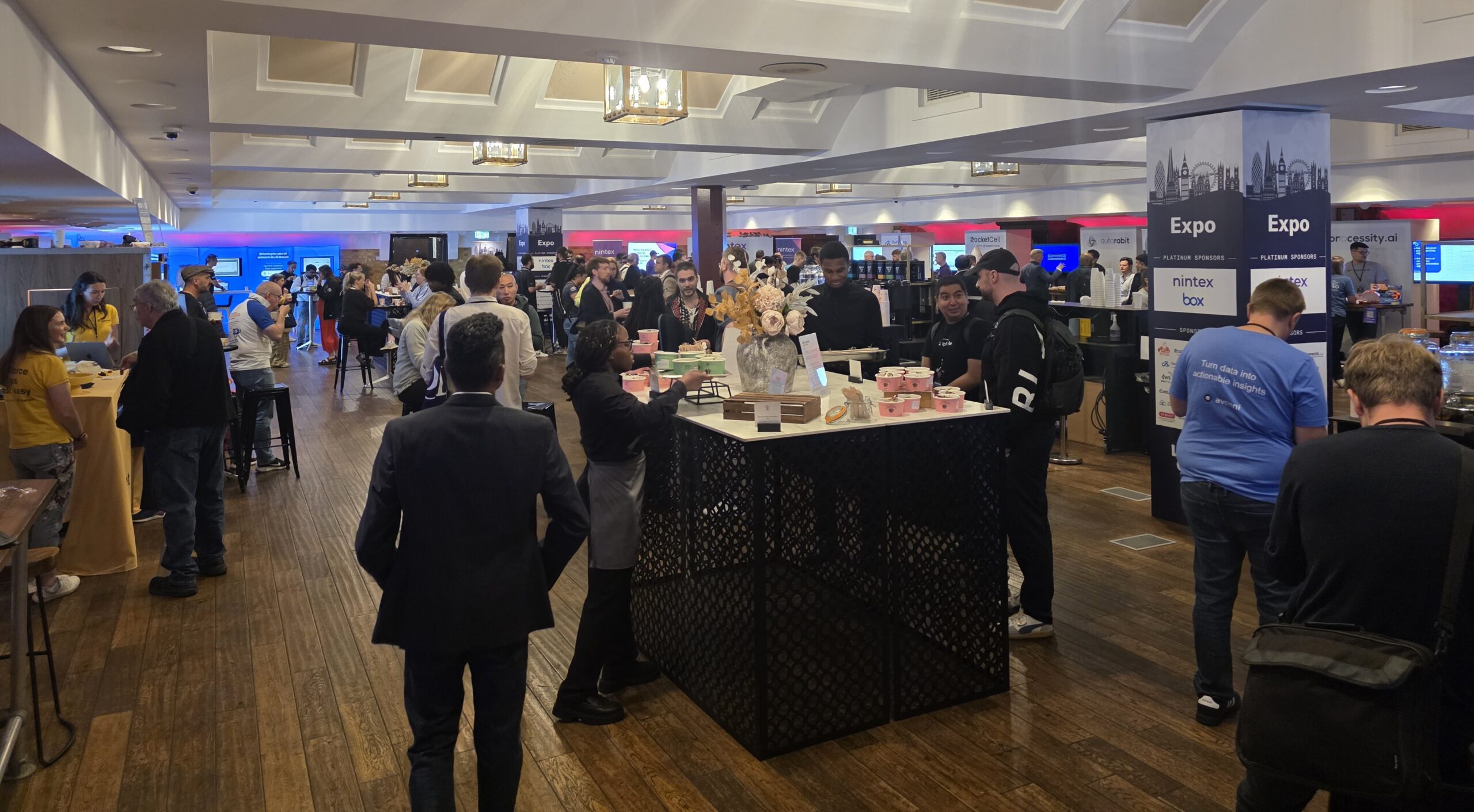
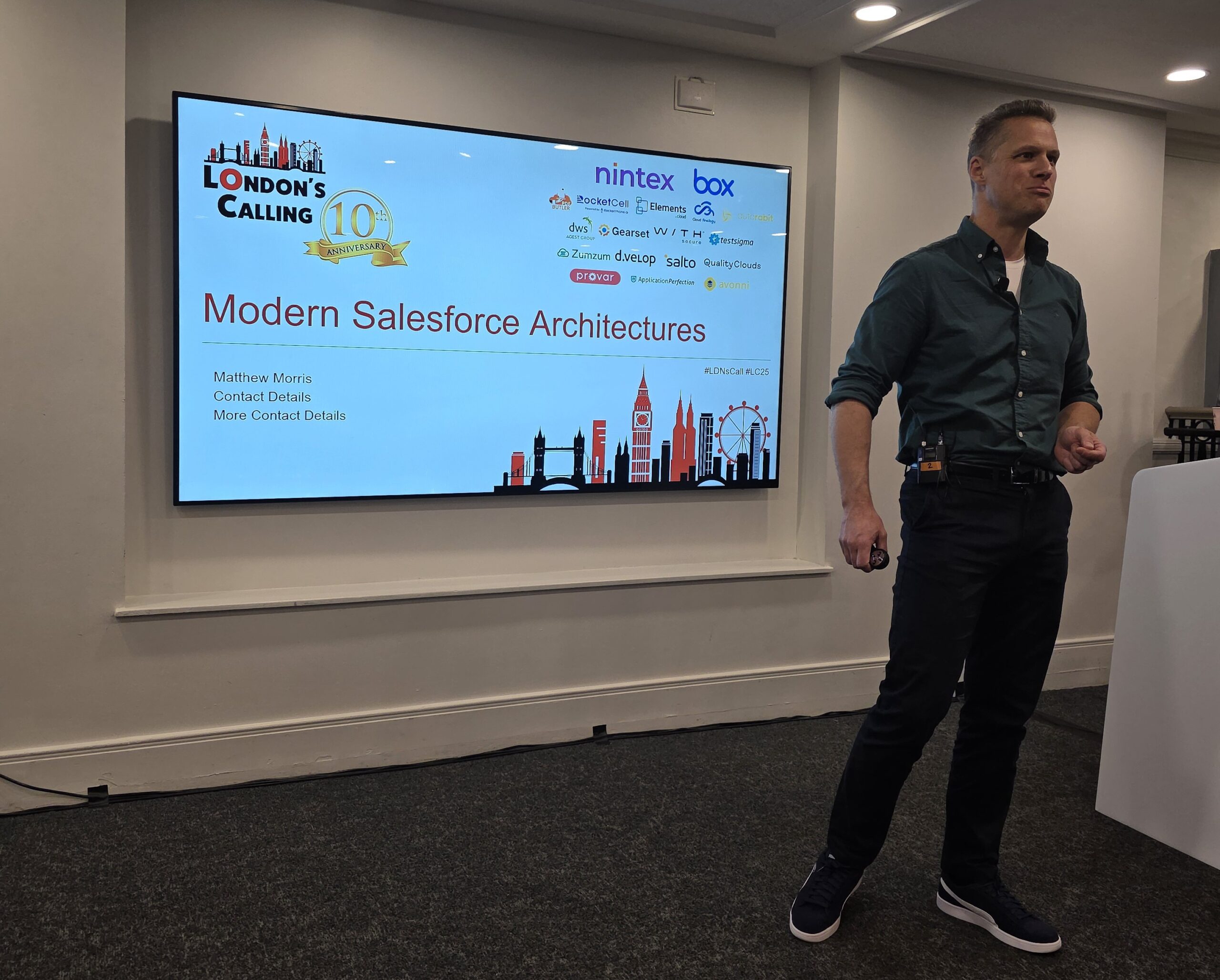
London’s Calling, the community-driven Salesforce conference, celebrated its 10th anniversary this year and remains a vital event in the English Salesforce calendar. Strategically positioned just before the main Salesforce event, London’s Calling offers attendees an authentic and open space for discussions that might otherwise be constrained at larger corporate-controlled conferences.
Held once again at its familiar venue near Liverpool Street, London, the event was well-organised and featured the consistently high standards the Salesforce rabble have come to expect, including excellent catering and comfortable facilities. The building itselfhas lots of little nooks and deadends with Wi-Fi coverage where you can find people taking client calls.
As always, the sessions were the true highlight. Speakers openly addressed topics that many public personalities or vendors would hesitate to discuss in official settings.
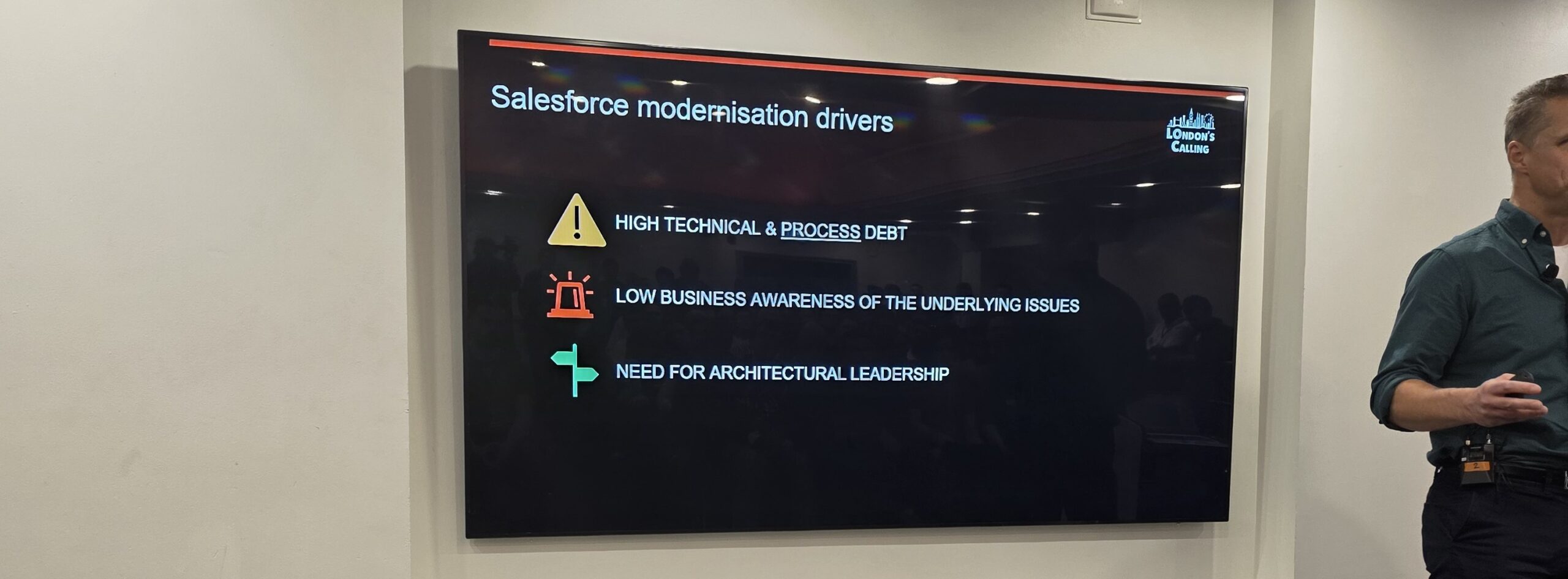
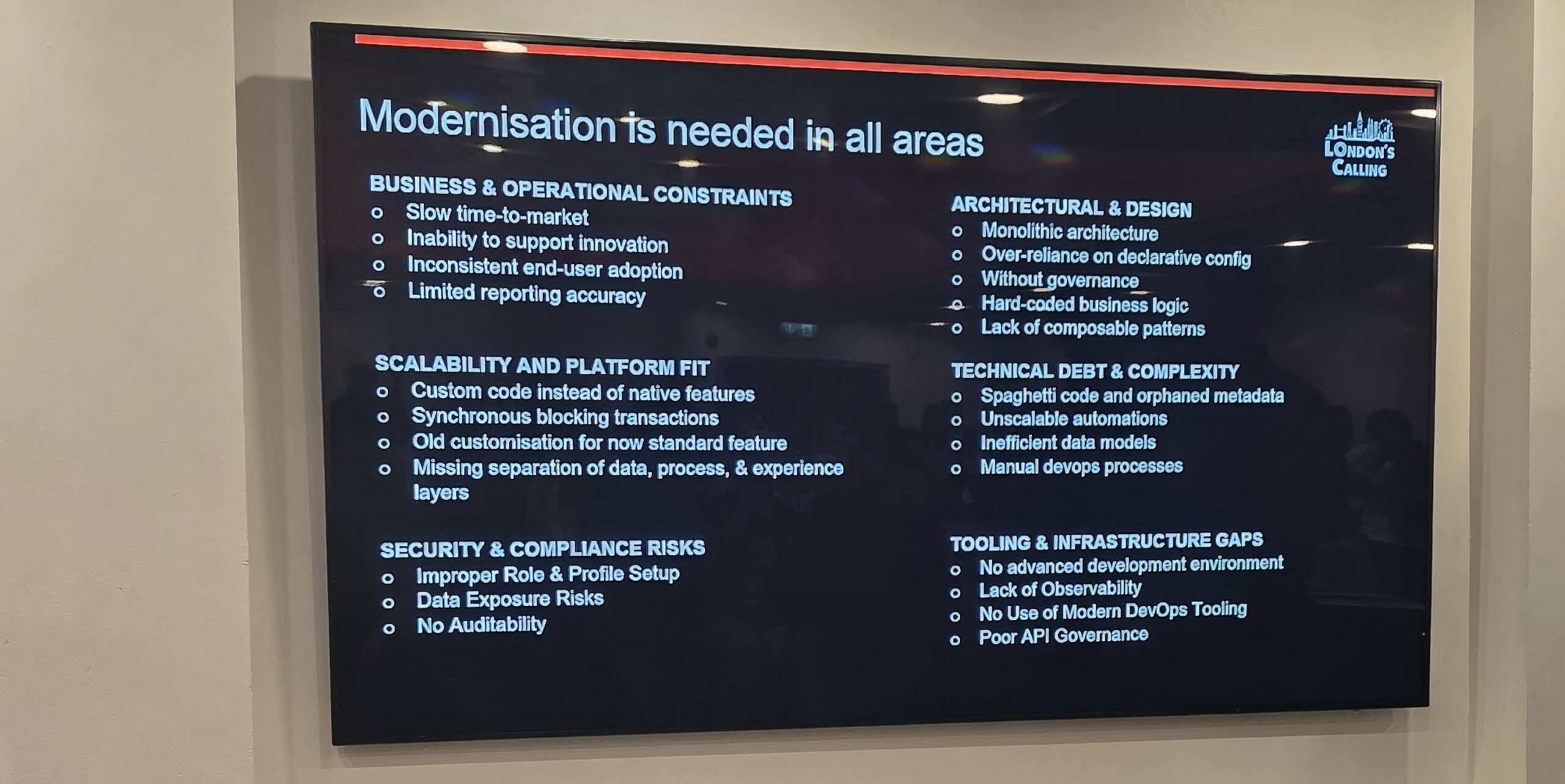
One standout session covered modern Salesforce architectures, providing valuable insights into the inherent challenges of rapid feature deployment without adequate long-term planning. It effectively showcased practical approaches for managing and correcting these issues.
Interestingly, a topic notably absent, but worthy of community attention, was the lack of standardised practices around documentation and architecture handover within Salesforce implementations.
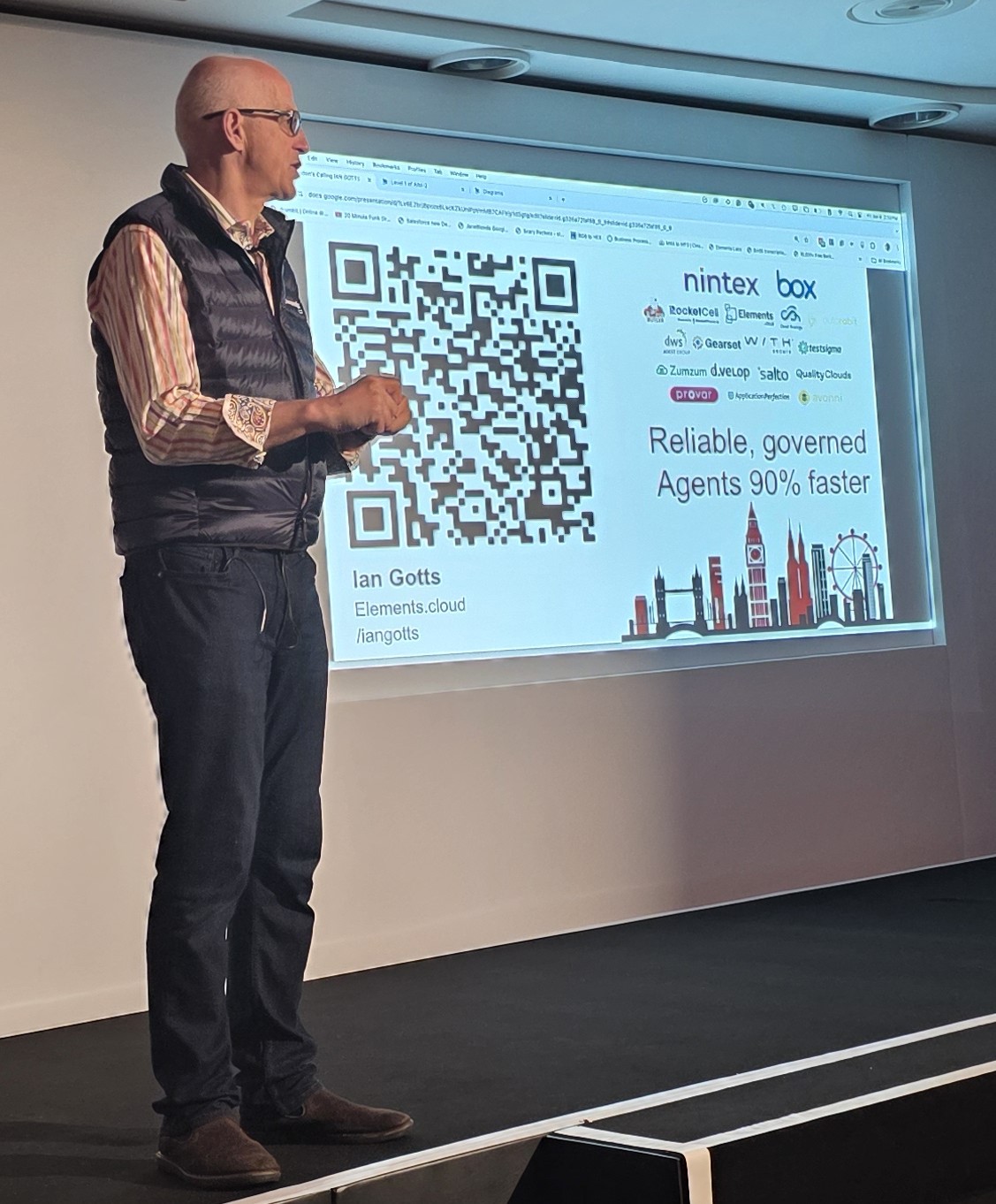
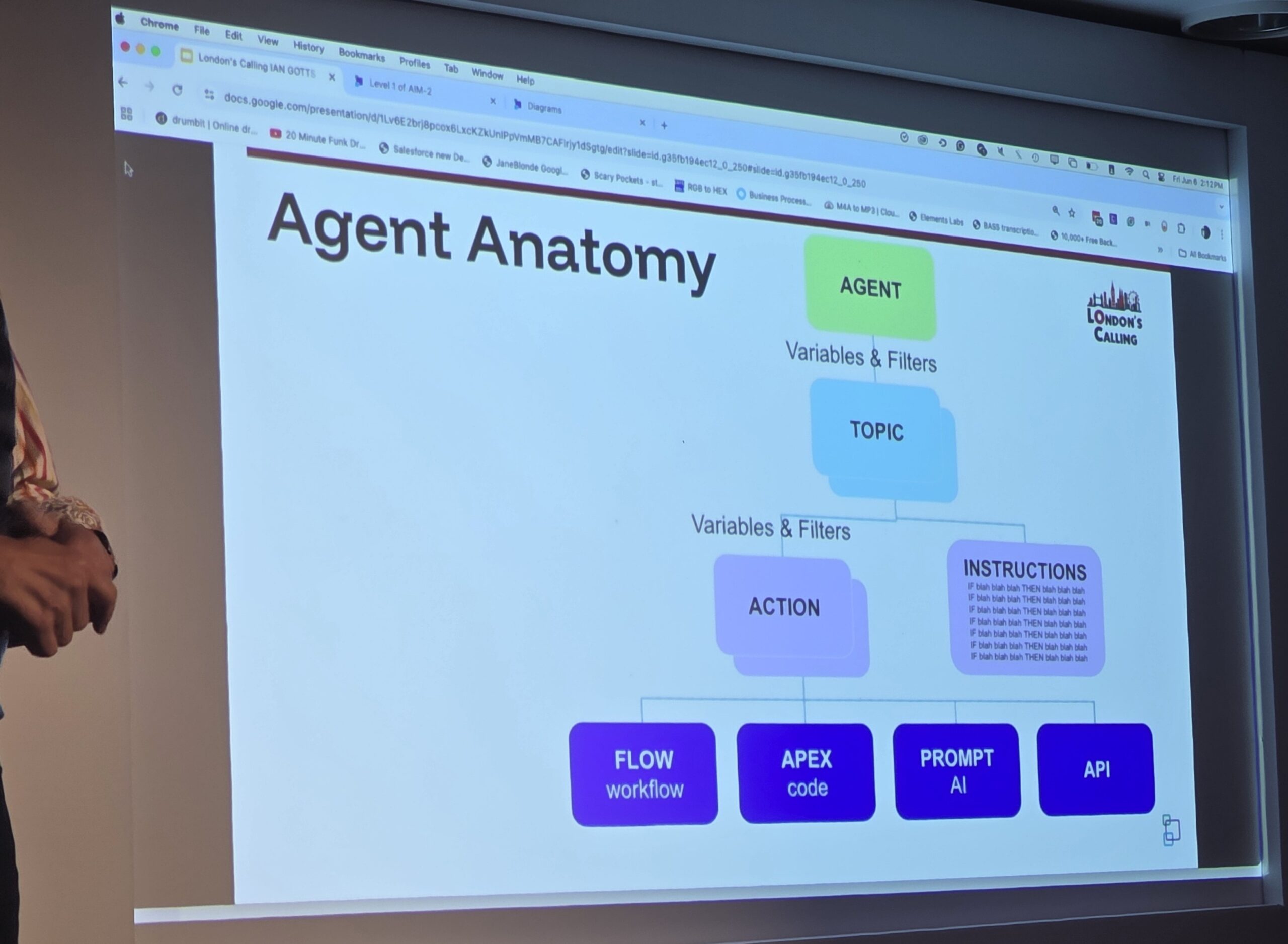
Another significant session tackled the complex issue of creating reliable, governed AI agents on Salesforce. This session bravely addressed common hesitations around deploying AI agents in live environments, including reliability, governance, coding best practices, and cost-effectiveness. It not only highlighted these challenges but also provided actionable guidance and practical strategies for overcoming them.
Of course, London’s Calling wouldn’t be complete without its much-loved traditions, such as the iconic event t-shirt (and the huge queue to get them), which attendees proudly wore at the subsequent Salesforce event. And although I once again missed the highly acclaimed after-party, its reputation remains strong as an integral part of the community experience and a good value piss up.
London’s Calling continues to offer a crucial, unfiltered platform for genuine insights and professional growth in the Salesforce community. It’s an event I look forward to attending each year.
Every time I attend the First Tuesday Club, I find myself wondering why I don’t make it a monthly priority. With ever-flowing drinks, fantastic food, and great company, it’s genuinely puzzling that it isn’t permanently fixed in my diary. But such is the nature of the corporate frenzy; we often take such opportunities for granted.
I found the atmosphere as welcoming as ever. The gathering typically hosts around 80 to 100 attendees, a solid mix of familiar faces and new introductions. It’s always nice catching up, exchanging insights, and sharing anecdotes, particularly about the ongoing adventures in the security field. This night is one of those rare places where professionals can relax, share openly 1, and feel genuinely supported amidst the relentless security battles we all face.
Mr. and Mrs. Sutherland were there as always, a consistent presence over many years, this time introducing their daughter, a fab moment that made me feel somewhat ancient but also hopeful seeing a new generation stepping forward. As always, the evening featured a fantastic spread, perfectly balancing a comfortable atmosphere with just enough corporate sponsorship to ensure everything was covered.
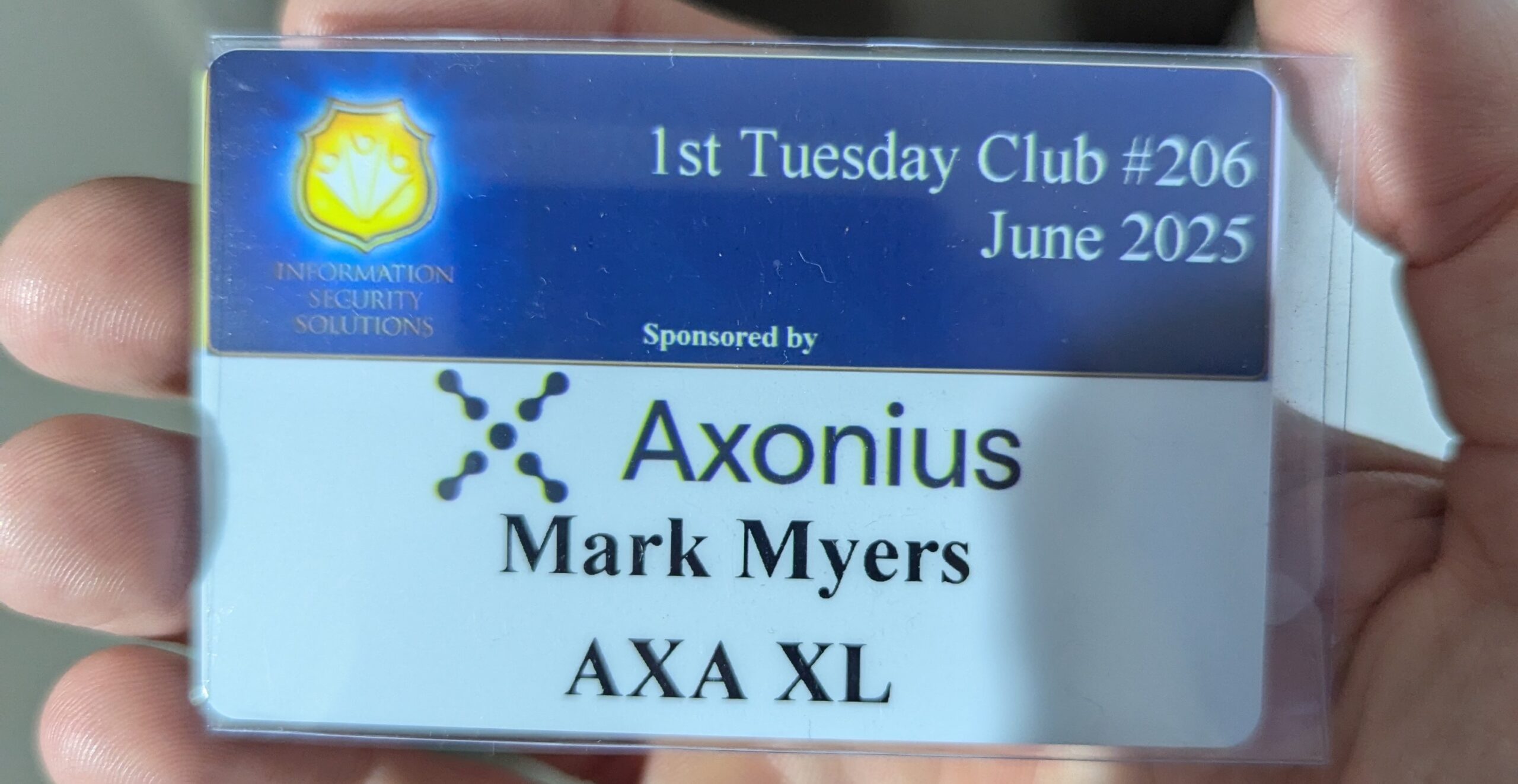
This particular event was sponsored by Axonius , an impressive company whose services seem like an excellent fit for one of my clients. I had an interesting and no-pressure conversation with one of their team members. Rather than heavy-handed selling, the representatives casually mingled and engaged naturally with attendees, meaning that everything stayed nice and relaxed.
The First Tuesday Club has been a valuable part of my professional life for decades. Each visit reinforces why I value it so highly. I’m introducing a new colleague to it next month, hoping they find as much value and enjoyment in it as I have. In a world where cybersecurity challenges grow increasingly complex, having a place like the First Tuesday Club, where learning and networking occur in a stress-free environment, is more important than ever.
within the bounds of client confidentiality, of course[↩]
I had a fascinating experience recently that really highlighted how far software development has come, and how some things haven’t changed at all. It began, as many of my days do, with trying to resolve a conflict between two technical teams who weren’t seeing eye-to-eye.
Normally, getting everyone in a room to clarify dependencies is straightforward enough, but this time, something unusual was at play.
On the surface, it seemed like a typical methodology clash: one team heavily leaned toward waterfall approaches, while the other embraced agile development. Easy enough, right? Just find common ground between methods and move on.
But as the discussion unfolded, it quickly became apparent there was more to the issue. Both teams, despite their methodological differences, consisted mainly of younger developers with around ten years of professional experience. And yet, the deeper we dug, the clearer it became that struggles to understand each other’s challenges was rooted not in methods, but in the technologies they were using.
One team was working with a cloud-based service UI, a modern SaaS environment where flexibility is the norm. Defining and changing fields in such systems is almost effortless: you can quickly roll back changes, validation updates automatically, and code provides clear flags and warnings. Fields are disposable, easy to manage, and quick to modify even at the last minute.
Contrast this with the other team’s world, developing for a mainframe system that has been around for more than three decades.
Here, field definitions are anything but flexible. Fields are strictly limited in length, difficult to modify once provisioned, and changing field types after the fact is practically impossible. In some cases, the system demands pre-provisioning fields en masse just to have some flexibility later, making every change a monumental effort.
This stark difference in environments had created a disconnect. Each team was frustrated, not realising the other’s technical constraints. The cloud-based team couldn’t comprehend why changing fields could be such a big deal, while the mainframe team couldn’t understand why the cloud team kept pushing changes that seemed careless and that made assumptions.
It was fascinating because usually, this kind of misunderstanding happens between technical and non-technical teams or between business stakeholders and developers. But this was a rare case of two technical teams misunderstanding each other simply because their platforms and experiences were worlds apart.
For me, it was a powerful reminder: integration specialists and project managers today don’t just bridge business requirements and technical execution, they also need to bridge knowledge gaps between entirely different technological eras. It’s not enough to understand the technology you work with; you have to grasp the challenges faced by those working on completely different platforms, sometimes from a completely different generation of computing.
Recently, we encountered an interesting issue related to field size validation when integrating newer systems with older backend systems, particularly involving Chinese characters and UTF-8 encoding.
Modern systems typically handle Chinese characters correctly as single characters. Thus, if you set a validation limit of, say, 255 characters on an input field, each Chinese character will count against 1 of that limit.
However, when these characters are passed to older backend systems still using UTF-8 encoding, each Chinese character may expand into multiple UTF-8 character slots. As a result, data originally within your set limit can unexpectedly exceed the backend’s field size, causing overflow errors or truncation.
You can see this in action below, comparing the results of encoding various characters to UTF-8:
3D printers are quickly becoming as common in our homes as any other domestic appliance, at least, that’s how it feels these days. I’ve had one for about a year now and use it about as often as I use a jigsaw or a carpet cleaner. If you’re just starting out on your 3D printing journey (or deciding if you even want to), here are some practical, real-world tips, especially for those living in England’s urban areas.
1) Treat It Like a Domestic Appliance
Yes, you can take 3D printing up as a hobby, tweaking every setting, experimenting with exotic filaments, and chasing the cutting edge. But don’t stress if your printer isn’t revolutionising your life immediately. For many people, it’s simply another tool in the home. Use it for everyday tasks, quick fixes, or other hobbies. You don’t have to turn it into your entire world.
2) If It’s Broken, It’s Probably You
Failed print? Weird warping or stringing? Nine times out of ten, the culprit is user error. Maybe you forgot to clean the print bed, left greasy fingerprints all over it, or fiddled with software settings that you didn’t fully understand. 3D printers are more reliable than we give them credit for, most problems trace back to how we set them up or maintain them.
3) Essential Accessories (Don’t Go Overboard)
It’s tempting to buy every accessory under the sun. If you want just the essentials, however, here’s a short list:
A paving stone: Putting your printer on a paving stone helps reduce vibrations and keeps it stable. It’s cheap, nearly indestructible, and incredibly effective.
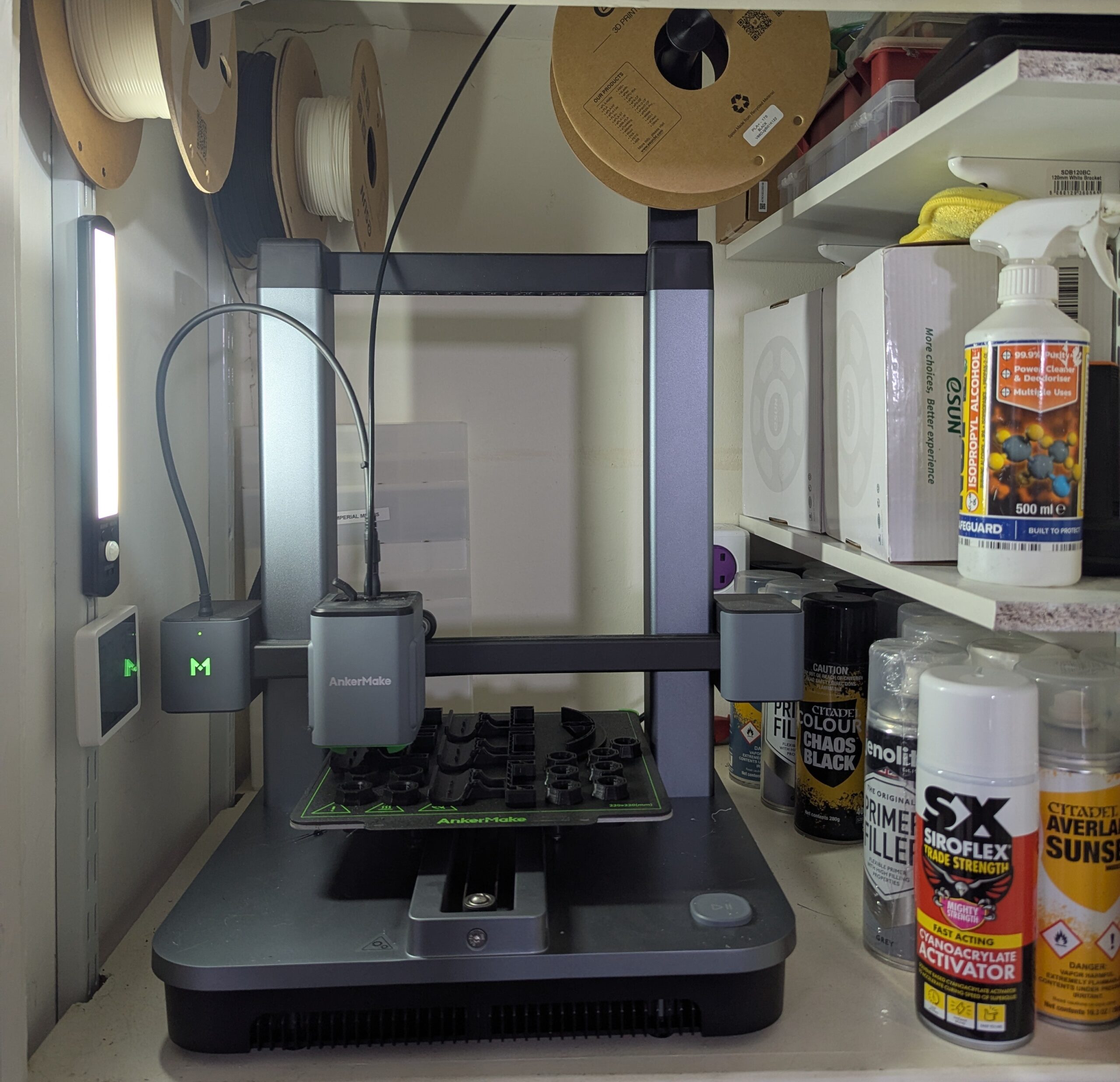
Isopropyl alcohol (IPA) in a spray bottle: Ideal for cleaning your print bed and other parts of the printer. Buy it in bulk and decant it into a smaller spray bottle for daily use poarticually for cleaning the filament bed.
Callipers: Handy for measuring the thickness of parts or filament and checking dimensions of areas you want your print jobs to fit into.
A decent steel ruler: Because bad measurements are the murder of all fun.
Other add-ons depend on your environment. If you have a cupboard or closed space for your printer, you might not need a filament dryer. i just store my part-used filament above the printer and that keeps it dry enough in England
4) Noise Is a Factor
3D printers can be loud, and long print jobs sometimes run overnight. If you’re in an urban setting with close neighbours, or if you work from home and worry about background noise on calls, consider placing your printer in a cupboard or enclosed space. A simple trick is to hang towels in front of the cupboard door to help dampen the sound. Fancier enclosures are nice, but towels are cheaper and surprisingly effective.
5) Don’t Overcomplicate Filaments
For FDM or filament printing, which is the most common kind you will see, just find a reliable filament brand (for instance, eSun PLA+), pick a couple of colours you like (black and white often cover most household needs), and stick with them. You can certainly go wild with speciality filaments, but for daily, practical prints, you don’t need an entire rainbow or a dozen exotic materials.
6) Resin Printing? Probably Not
If you’re in a small urban space (particularly with kids or pets), resin printing is likely off the table, much as they are awesome for highly detailed printing for things like models. Resin is toxic, the fumes are unpleasant, and disposing of resin waste responsibly can be a nightmare. Unless you have a dedicated, well-ventilated workshop or shed (far from common in many city flats and terrace houses), an FDM printer is your safest bet.
7) Ignore the “Arms Race”
The 3D printing market is full of new “game-changing” models every other month. Don’t get caught in the hype. Choose a printer that’s well-supported, does what you need, and fits your budget. Treat it like buying a car: you want reliability, availability of spare parts, and basic features that meet your needs. Also, 3D printers are great for helping out friends who don’t have one. Filament is relatively cheap, and you can ask them to buy you a spool if you end up printing a lot for them.
8) Be Realistic About Recycling
PLA and other common 3D filaments are technically recyclable, but don’t put it with your other recycling plastic, as the centres can’t tell them apart. You’ll likely end up with a bin of wasted prints and supports. If you truly want to recycle, you may have to pay a specialist service. Be aware that “biodegradable” doesn’t mean it vanishes in weeks or months—it can take years. I use a propper dedicated recycling company and fill up a box which i have to have paid to be taken away (3dprintingwaste.co.uk)
9) Beware of Supports
Supports can help print more complex designs, but they waste filament, increase print time, and can be frustrating to remove cleanly. Wherever possible, seek out support-free designs or modify models to minimise the need for them. Your printer will thank you, and so will your recycling bin.
10) Finishing Touches (Without Overdoing It)
Super Glue: Works brilliantly for bonding PLA prints. The resulting join is often stronger than the original piece. Sanding: Go easy, sanding creates microplastics. A good filler primer (e.g., Genolite Original Primer) can smooth out surfaces if you care about the final finish. Painting: If you’re painting, a basic primer plus acrylic paints do the job nicely. Again, keep an eye on fumes and ventilation.
11) Choosing a Brand
Plenty of manufacturers want you to treat your 3D printer like a vacuum cleaner: buy replacement parts at their schedule and pay a premium for “official” bits. If that puts you off, consider something more open-source friendly like Prusa. They’re pricier and not as “plug-and-play” polished, but you’ll have more freedom to upgrade and maintain your printer without feeling like the company is constantly trying to sell you more parts. In the end, the brand you pick should be one that you trust to give you decent support (whether official or community-based), reasonable spare-part availability, and a long service life. If you don’t mind the consumerist approach, pick whatever brand suits your budget and tolerance for maintenance.
Final Thoughts
3D printing has grown beyond the realm of hardcore hobbyists tinkering in their sheds. It’s now a practical, everyday tool, especially for quick home fixes or small, personalised projects for those in an urban environment. You do have to think about noise, ventilation, and space more than someone in a big house with a sprawling workshop. But once you have those sorted, a 3D printer can be a wonderful addition to your home. Just remember: keep it clean, keep it stable (hello, paving stone!), buy good filament, and don’t worry if you’re not pushing the cutting edge of 3D printing technology. Sometimes, a simple printer that “just works” is all you need.